we are successfully executing projects in uae

Civil Construction Contractor in UAE How to Choose and Compare
A civil construction contractor in UAE is a licensed contractor that builds the structural and infrastructure parts of a project, such as earthworks, foundations, concrete structures, roads, drainage, and utilities.
CONSTRUCTION IN UAE
Godha
2/23/202613 min read
Civil Construction Contractor in UAE
To hire the right one, you need to verify licensing and classification, review comparable projects, confirm QA QC and safety systems, and compare contract terms, testing plans, and approval readiness.
Choosing a contractor in the UAE is not just about price. It’s about proof, process, and how well they handle permits, utilities, and quality checks.
This guide is written to help you shortlist, compare, and hire with fewer surprises, whether you’re a first-time buyer or a seasoned project professional.
What does a civil construction contractor in UAE do
A civil construction contractor in UAE executes the core works that make a site buildable and stable, including site formation, excavation, foundations, reinforced concrete, infrastructure networks, and external works. They also manage subcontractors, materials, site safety, testing, inspections, and handover documentation.
Civil works are the backbone. If they’re wrong, everything above them suffers.
In practical terms, a civil contractor may deliver:
Site clearance, excavation, grading, and compaction
Dewatering where needed
Piling, shoring, and foundation systems
Reinforced concrete works including slabs, retaining walls, and structures
Internal roads, pavements, kerbs, and asphalt
Stormwater drainage, culverts, and manholes
Utility corridors, duct banks, and service trenching
Boundary walls and external works
Industrial civil works like equipment bases and heavy-duty slabs
They also coordinate testing and inspection requests so works can progress without stop-start delays.
Why do people search for civil construction contractor in UAE
Most searches come from buyers who need a contractor they can trust for infrastructure, structural works, or site enabling works in a regulated environment. They want speed, cost clarity, and predictable quality, plus confidence that approvals and inspections will not derail the schedule.
In the UAE, you often deal with tight project timelines and multiple approval touchpoints.
That means your contractor must be good at execution and paperwork.
If you’re hiring, your real goal is simple. You want a contractor that delivers the scope you expect, passes inspections, and does not turn the project into a claims fight.
What civil construction services in UAE should a strong contractor offer
A strong civil construction contractor in UAE offers a complete scope across enabling works, structural works, and infrastructure networks, with documented QA QC and safe work systems. You should expect clear method statements, inspection plans, and testing schedules, not just a service list.
Civil Construction Services:
Site enabling and groundworks
Site clearance and setting out
Excavation, backfilling, and compaction
Soil improvement where required
Temporary access roads and haul routes
Dewatering and groundwater control
Foundations and structural concrete
Raft foundations, footings, and ground beams
Piling and pile caps
Retaining walls and concrete tanks
Industrial slabs and hardstands
Concrete repair and strengthening where needed
Infrastructure and utilities
Stormwater drainage networks
Sewer and water pipeline corridors (where within scope)
Utility ducting and cable trenches
Manholes, chambers, and catch basins
Tie-ins and protection works coordination
Roads and external works
Subbase and base course works
Kerbs, paving, and asphalt surfacing
Road markings and signage coordination
Boundary walls and external civil works
If a contractor claims to do all of this, ask for three proof items: a similar project list, a sample inspection and test plan, and a sample set of handover documents.
Industrial construction services in UAE
Industrial construction services in the UAE focus on building facilities such as warehouses, factories, logistics hubs, processing plants, and heavy industrial units. These projects demand stronger foundations, higher load slabs, equipment bases, utility corridors, and strict coordination with power, water, and fire safety authorities. Tolerances are tighter, and QA QC is more critical because machinery alignment, vibration control, and floor flatness directly affect operations.
In industrial work, I pay close attention to geotechnical data, slab design, and construction joints. A small mistake in level or curing can create long-term operational problems. That is why contractors handling industrial civil works must show proven experience with heavy-duty slabs, large pour sequencing, anchor bolt setting, and structured testing plans.
How do you verify a civil contractor is legally allowed to work in UAE
You verify a civil contractor by checking their valid trade license, municipality or authority registration, project classification, and any required approvals for the type and value of work. You should also confirm insurance coverage and whether key roles like site engineer and safety officer are provided in-house.
Start with basics.
Trade license and legal entity details
Relevant civil contracting activity listed on the license
Contractor registration status for the emirate and project type
Insurance certificates (contractors all-risk, third party liability, workmen compensation where applicable)
Authorized signatories and who signs contracts and variation orders
In Dubai, construction is tied to a permit and completion workflow run through Dubai Municipality’s building permit procedures. Your contractor must be ready to support inspections and completion steps, not just pour concrete.
In Abu Dhabi, you will often interface with government portals and authorities under the Department of Municipalities and Transport ecosystem.
If your contractor can’t explain how approvals and inspections are handled on your type of project, treat it as a risk, even if their price looks great.
How do you prequalify a civil construction contractor in UAE
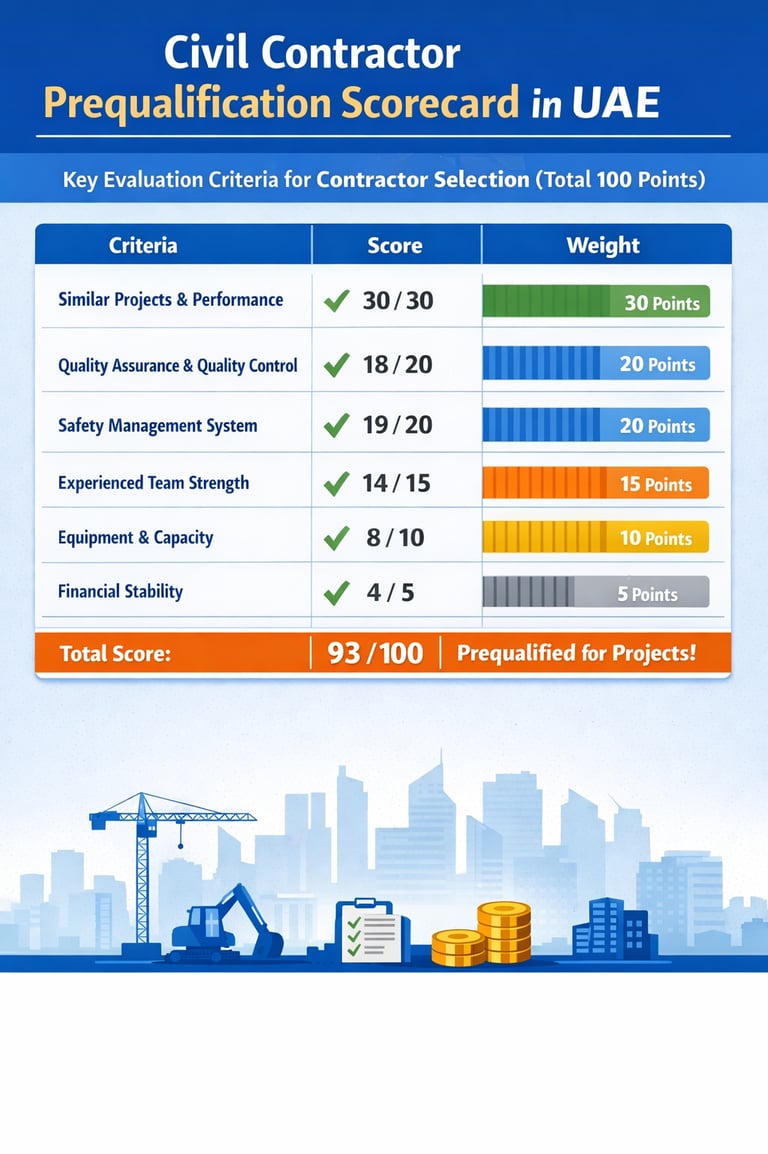
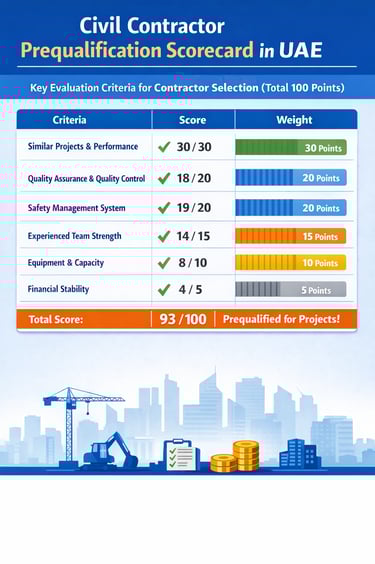
Prequalification is a structured way to shortlist civil contractors based on evidence, not marketing. You request a prequalification pack, review their similar project experience, QA QC and HSE systems, key staff, equipment, capacity, and financial stability, then score them before inviting final bids.
What to ask for in a prequalification pack
Ask for these documents and keep them on file:
Company and compliance
Trade license and registrations
Organization chart and key contacts
Insurance certificates
Litigation or dispute disclosure statement (basic, factual)
Experience
5 to 10 comparable projects with scope, dates, client, contract value band, and completion status
Completion certificates or client reference letters where available
Photos with dates and short scope notes
People
CVs for project manager, construction manager, site engineer, QA QC engineer, HSE officer
Relevant certifications and training records
Quality
Quality policy and QA QC procedures
Sample inspection and test plan
Sample material submittal log
Safety
HSE plan template
Incident reporting process
Toolbox talk program evidence
Emergency response plan
Capacity
Current project list with manpower and equipment allocations
Owned equipment list and major rentals plan
Commercial
Audited financial statements or a bank reference letter
Payment terms expectations
A simple scorecard you can actually use
Give each contractor a score out of 100.
Similar projects and performance 30
QA QC system quality 20
Safety system and track record 20
Team strength and availability 15
Capacity and equipment readiness 10
Commercial and financial stability 5
This approach makes bid comparisons cleaner later. It also reduces the chance you choose a contractor who “sounds good” but struggles on site.
What should you send to get an accurate civil construction quotation in UAE
To get a usable quote, you need to send a clear scope, drawings, specifications, site constraints, and the approvals assumptions. If you only send a concept drawing, you’ll get vague pricing, exclusions, and later variations.
This is where many projects start drifting.
Send these items before you ask for a price:
Technical documents
IFC drawings or the latest coordinated set
Project specifications including concrete grade requirements and durability notes
Geotechnical report and soil investigation results
Utility layouts and known constraints
Survey drawings and levels
Any authority requirements already known
Scope definition
What is included and excluded
Temporary works responsibilities
Testing responsibilities
Traffic management responsibilities if near roads
Who provides water and power during construction
Commercial and schedule inputs
Desired start date and required completion date
Working hours and any restrictions
Payment terms and retention expectations
Bid submission format you want
If you do this well, you reduce variation orders later. You also make it easier to compare bids fairly.
What should a civil construction proposal include if it’s a serious contractor
A serious proposal includes a detailed scope breakdown, priced bill of quantities or schedule of rates, a realistic program, a testing and inspection plan, key staff assignments, equipment plan, and clear exclusions. It should also state how permits and NOCs will be coordinated.
When I review tenders, I look for clarity. Clear scope equals fewer disputes.
Ask contractors to include:
Detailed scope and method approach
Program with milestones and critical path notes
Temporary works approach and responsibilities
Inspection and test plan summary
Material submittal and approval process
Safety plan summary and site logistics layout
Resource plan and equipment list
Explicit exclusions and assumptions
If a proposal is only a one-page price and a promise, it’s not a proposal. It’s a risk transfer attempt.
Which contract type is best for civil works in UAE
The best contract type depends on how complete your design is and how uncertain the ground conditions are. Lump sum works best when drawings and quantities are stable. Remeasurement or unit-rate contracts reduce risk when quantities may change, especially in earthworks and utilities.
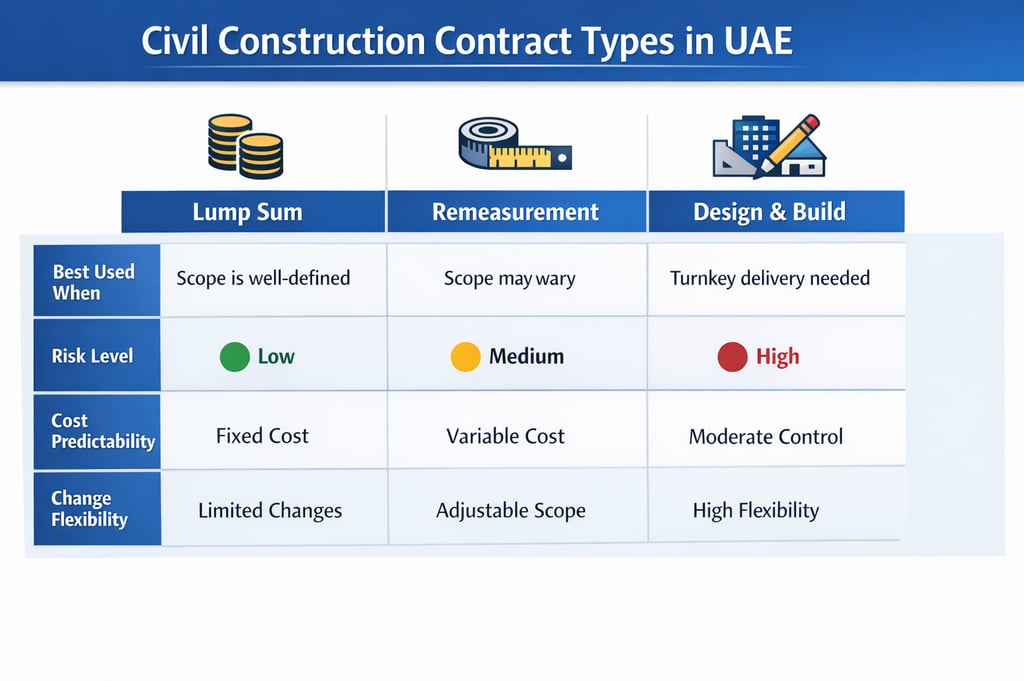
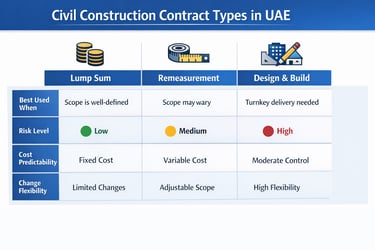
Lump sum
Best when:
Design is complete
Scope boundaries are tight
Ground conditions are well understood
Risk:
Contractor prices in contingencies
Variations become a battlefield if scope isn’t clean
Remeasurement or unit-rate
Best when:
Quantities are uncertain (earthworks, trenching, utilities)
You expect design adjustments
You want transparent measurement rules
Risk:
Requires strong measurement process and site records
Final cost can drift if controls are weak
Design and build
Best when:
You want one party accountable for design coordination and build
You want faster sequencing
Risk:
Needs careful employer requirements and performance specs
You must verify the contractor’s design competence
If you are new to contracting, it’s worth getting a quantity surveyor or experienced consultant to help you pick the structure. This one decision can prevent months of disputes later.
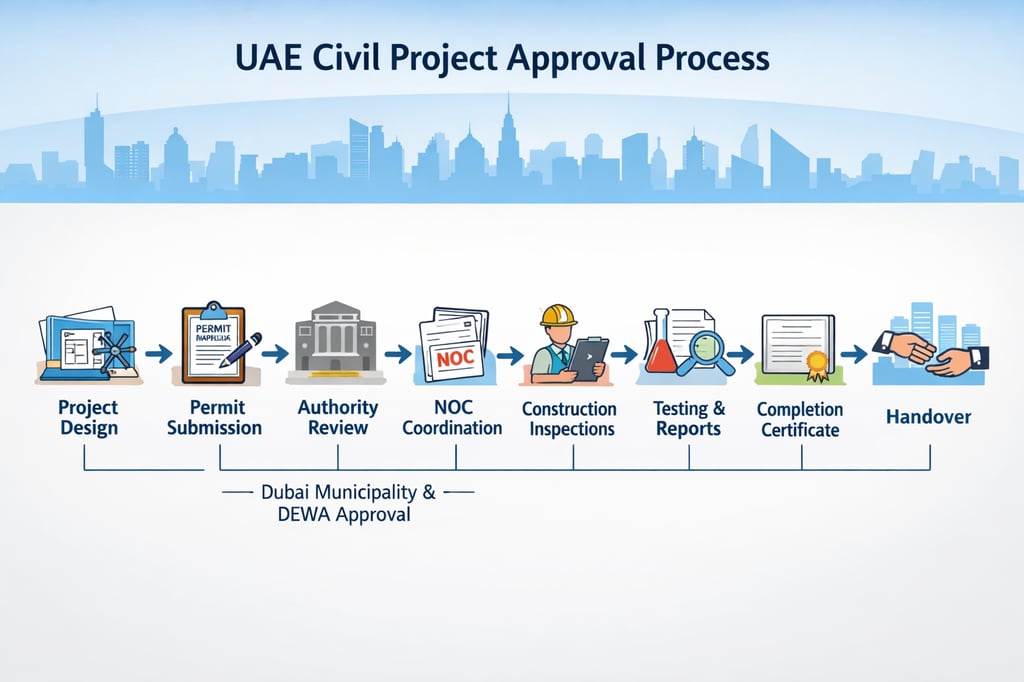
How do authority approvals and NOCs affect civil construction schedules in UAE
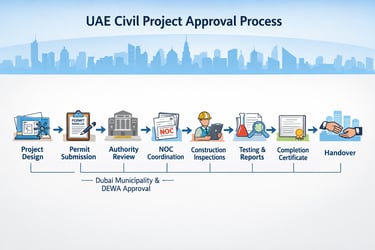
Authority approvals and NOCs can control your critical path, especially when works touch utilities, roads, and final handover. Your contractor needs a documented approvals plan, inspection readiness, and clear responsibility splits between contractor, consultant, and client.
In Dubai, building permit procedures and completion certificate steps are part of how the city ensures buildings meet approved specifications and safety requirements.
On the utilities side, DEWA’s building NOC process and integrated workflows can apply depending on the licensing authority, and projects may flow through Dubai’s permit system where DEWA receives requests through integration.
What your contractor should be ready to manage
Permit and inspection request scheduling
Utility coordination submissions
As-built documentation compilation
Close-out and completion certificate support
If a contractor tells you approvals are “not our issue”, that’s a warning sign.
Even when a consultant handles submissions, the contractor still must build approved drawings, maintain records, and pass inspections.
What QA QC tests should you expect on a UAE civil construction project
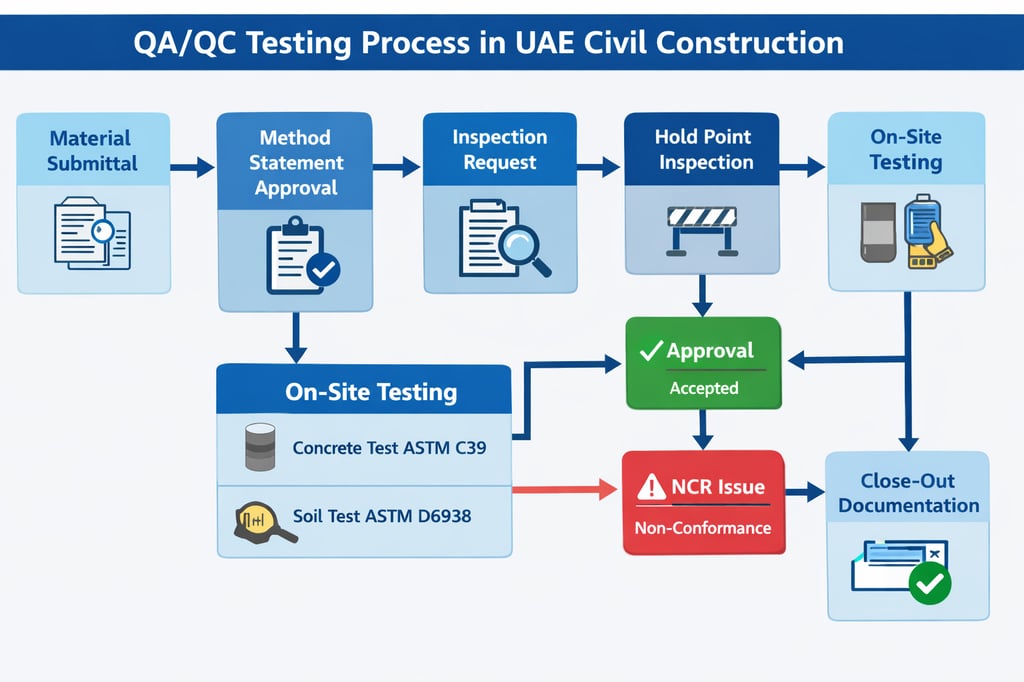
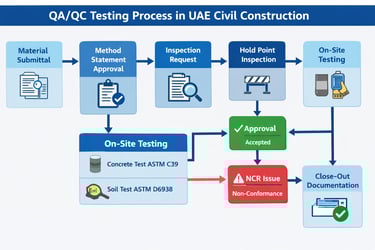
You should expect a documented inspection and test plan covering concrete strength testing, compaction and density testing for backfill and subbase, survey verification, and material approvals. The exact tests depend on the scope, but credible contractors align their methods to recognized standards and keep traceable records.
This is one of the safest, most quotable ways to build trust, because it’s not marketing. It’s controlled.
Concrete strength testing
Concrete is often verified using compressive strength tests on cylinders or cores. ASTM C39 covers determination of compressive strength for cylindrical concrete specimens.
What to ask for:
Sampling plan and frequency
Test reports tied to pour cards and location
Clear acceptance criteria tied to specs
Compaction and density testing for soil and backfill
Backfill and subbase quality is often verified with in-place density and moisture tests. ASTM D6938 describes nuclear gauge procedures for measuring in-place density and moisture of soil and soil-aggregate.
What to ask for:
Layer thickness and compaction method statements
Density test frequency per area or per layer
Results mapped to test locations
Asphalt and roadworks testing
If your scope includes roadworks, you should expect:
Material approvals for asphalt mixes
Field density checks and core sampling where required
Line and level checks for kerbs, levels, and crossfall
Your project specifications and authority requirements will drive the exact test set.
Waterproofing and durability checks
If you have basements, tanks, or wet areas:
Waterproofing inspections at key stages
Protection board installation checks
Any integrity testing your specs require
Survey control and setting out
A contractor should maintain:
Survey control points
Setting out records
As-built surveys for handover
Ask to see a sample inspection and test plan early. A good contractor already has a standard template they tailor per project.
What does ISO certification actually tell you about a civil contractor
ISO certification can indicate that a contractor follows a documented management system for quality and safety, but it does not guarantee good execution on your project. Use it as one data point, then verify site-level controls like inspection plans, competent staff, and testing records.
ISO 9001 is the international standard that specifies requirements for a quality management system.
ISO 45001 specifies requirements for an occupational health and safety management system to manage risks and improve OH&S performance.
How to use this without getting misled:
Ask for the certification scope, issuer, and validity dates
Ask how the system shows up on site (QA checklists, NCR process, audits)
Ask who signs off on ITP hold points
If the contractor can’t connect their certification to real on-site practices, it’s just a badge.
What are the most common delays in UAE civil construction and how do you prevent them
The most common delays come from approvals and NOCs, utility conflicts, incomplete designs, long-lead materials, and poor site logistics. You prevent them by locking scope early, building an approvals schedule, running clash checks, and enforcing QA QC and reporting discipline from day one.
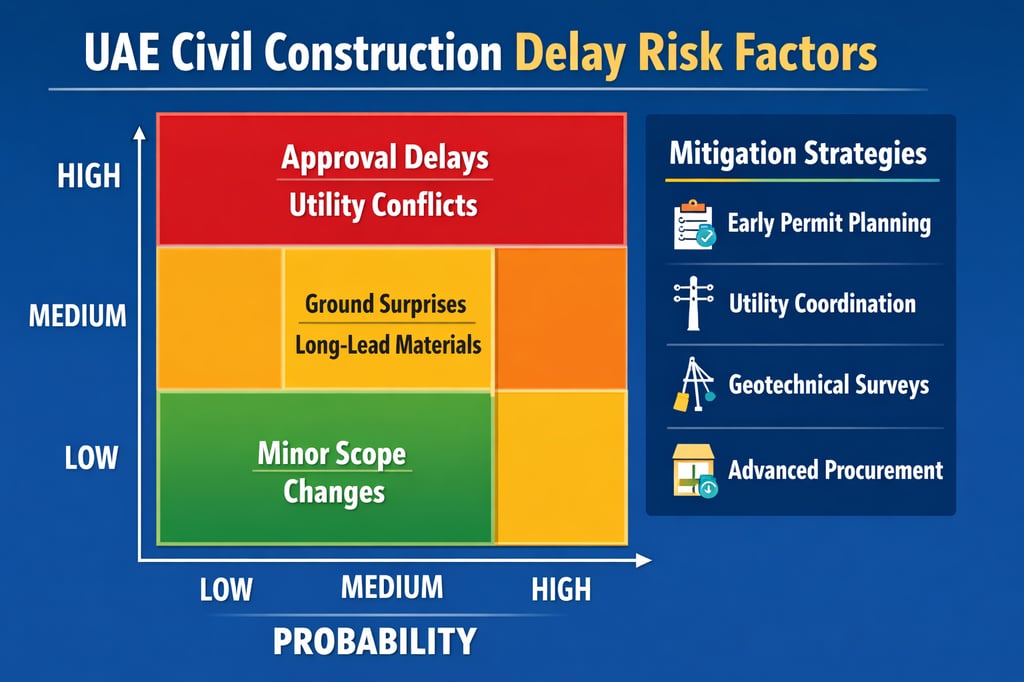
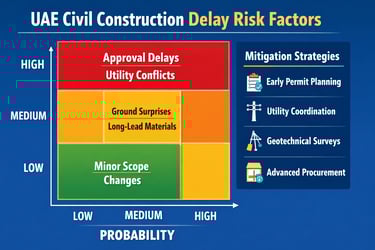
Approvals and inspections
Prevent it by:
Creating an approvals tracker with owners and dates
Scheduling inspections early and preparing hold point evidence
Keeping submittals tight and complete
Dubai Municipality’s permit procedures include steps for issuing building permits and completion certificates, and your project plan should align to that flow.
Utility conflicts
Prevent it by:
Confirming existing services through surveys and records
Planning trial pits where needed
Coordinating NOCs early with clear drawings
DEWA’s NOC process and technical references are part of that coordination world, especially when utilities are involved.
Ground conditions and quantity changes
Prevent it by:
Using a solid geotechnical report
Clarifying measurement rules in the contract
Building a contingency plan for disposal and replacement materials
Heat and productivity management
Prevent it by:
Planning pours and heavy work around workable windows
Ensuring the contractor has manpower depth
Enforcing hydration, shade, and safe work planning
A contractor with strong safety systems tends to manage productivity more consistently, because incidents and stop-work events are also schedule killers.
How do you compare civil contractors across Dubai, Abu Dhabi, and other emirates
The core evaluation criteria stay the same, but the approval workflows, portals, and authority touchpoints can change by emirate and by zone. Your contractor should demonstrate local execution experience and a clear approvals plan for the exact project location and authority.
Do not overcomplicate it.
Compare on:
Similar projects in the same emirate or authority environment
Familiarity with local inspection expectations
Document control maturity and as-built handover process
For Abu Dhabi, a useful starting reference for the government services and authority ecosystem is the Department of Municipalities and Transport portal and related government platforms.
For Dubai, Dubai Municipality’s building permit procedures are central to the compliance workflow.
If your site sits in a free zone or special development area, confirm the correct authority early, because the workflow can differ.
How do you shortlist and compare civil construction contractor bids without getting tricked
You compare bids by leveling scope, assumptions, unit rates, preliminaries, exclusions, and testing requirements, then checking schedule realism and resource plans. The lowest number often hides exclusions, weak QA, or unrealistic timelines.
This is where many buyers get burned.
Bid leveling
Ask yourself:
Are all bids pricing the same drawings and revision?
Are provisional sums and exclusions listed clearly?
Are testing and third-party lab costs included?
Are temporary works included?
Is dewatering included if your soil conditions need it?
Are permits and NOCs included or excluded?
Is disposal and hauling included with realistic assumptions?
Red flags that usually show up in writing
“As required” used repeatedly with no defined method
Missing program or a one-line timeline promise
No QA QC plan summary
No named project team
Large exclusions that are actually core scope
If you want to make this even tighter, use the scorecard method from prequalification, then apply a bid score.
Example weighting for final award:
Technical and QA QC 40
Commercial 35
Schedule and capacity 25
This keeps the award defensible and reduces the risk of regret later.
What does a good civil construction delivery process look like in UAE
A good process runs from planning and approvals through controlled execution and disciplined close-out. The contractor should show you how they handle submittals, inspections, testing, reporting, and handover, not just how they build.
Step 1 Preconstruction and planning
Review drawings, specs, and site constraints
Build a procurement plan and approvals tracker
Confirm testing labs and inspection plan
Set up site logistics and access
Step 2 Submittals and approvals readiness
Material submittals and method statements
Shop drawings where needed
Inspection and test plan approval
Utility coordination documentation
Step 3 Execution with control points
Setting out and survey control
Hold points for critical activities
Concrete pours with traceable pour cards
Backfilling with density tests and records
Step 4 Reporting and change control
Weekly progress reporting with photos and quantities
RFI and variation management
Updated schedules and look-ahead plans
Step 5 Testing, commissioning support, and close-out
Compile test reports and approvals
Deliver as-built drawings
Prepare handover dossiers and O&M inputs where relevant
Support completion certificate steps
Dubai Municipality’s process includes issuing completion certificates as part of the building compliance flow, so close-out is not optional.
How do you build durability and sustainability into UAE civil works without guesswork
You build durability by specifying the right materials and protections for local exposure conditions, then enforcing installation quality through inspections and testing. Sustainability improves when you reduce rework, optimize materials, manage waste, and plan lifecycle maintenance, not when you just add a green claim to a brochure.
The Gulf environment can be tough on structures.
Concrete mix design approvals tied to project specs
Proper curing and protection of concrete
Clear cover and reinforcement placement checks
Corrosion protection measures when required
Controlled backfill materials and compaction results
Drainage falls and outfall performance checks
A contractor that documents these steps makes your asset easier to maintain. It also reduces early failures.
If a contractor promises “maintenance-free construction”, treat it as marketing, not engineering.
FAQ
How do I find a civil construction contractor in UAE that fits my project type
Start with contractors who have delivered similar scope in the same project category, such as industrial, infrastructure, or commercial. Then prequalify using project sheets, QA QC proof, and team CVs. Avoid choosing based on brand name alone.
What is the fastest way to reduce variation orders in civil construction
Define scope clearly, send complete documents for pricing, and force written exclusions and assumptions in every bid. Use unit rates for uncertain quantities like earthworks. Track RFIs early and lock changes before execution starts.
Do civil contractors handle permits and approvals in UAE
They often support the process, but responsibility can be split between client, consultant, and contractor depending on the contract. In Dubai, the project must follow building permit and completion workflows under Dubai Municipality procedures. Always confirm who owns submissions and who owns inspection readiness.
What testing should I require on civil works
At minimum, require concrete strength testing and compaction and density testing for backfill and subbase, plus survey checks and material approvals. ASTM C39 is a widely referenced method for compressive strength of cylindrical concrete specimens, and ASTM D6938 is used for in-place density and moisture testing with nuclear gauges. The exact test list should match your specifications and authority requirements.
Are ISO 9001 and ISO 45001 important for civil contractors
They can be useful signals of documented quality and safety systems. ISO 9001 defines quality management system requirements, and ISO 45001 defines occupational health and safety management system requirements. Still, you should verify real site controls like inspection plans, testing records, and competent staff.
Final checklist before you hire a civil construction contractor in UAE
Before you sign, confirm legal eligibility, technical competence, QA QC and safety systems, approvals readiness, and contract clarity. If any of these are weak, you’re buying risk, even if the number looks good.
Use this final checklist:
License and registration verified
Similar projects proven with references or completion evidence
Named project team and availability confirmed
QA QC plan and inspection and test plan reviewed
Testing approach and lab coordination included in price
Safety plan and site logistics plan shared
Approvals tracker approach explained
Scope, exclusions, and assumptions leveled across bids
Contract type chosen to match uncertainty
Reporting cadence agreed in writing
Close-out and as-built expectations defined
If you build your decision around proof and process, you will usually outperform buyers who choose on price alone.
That is how you hire a civil construction contractor in UAE with confidence, and how you set your project up to pass inspections, control cost, and finish with fewer disputes.
About The Author
Mubashir Shakoor Godha
Mubashir Shakoor Godha is a blogger, digital marketer, and SEO specialist based in Pakistan. He started his journey in 2019 on Blogger.com and has since built and managed multiple websites that rank on Google and AI driven search platforms.
He is also the Founder of MSGDigitals, Top Rated Digital Marketing Agency in Pakistan, where he helps businesses grow through SEO, content strategy, and performance marketing.

Is a leading construction company in the UAE, delivering 100% results-driven solutions across the Energy and Industrial sectors. We empower a rapidly growing UAE to reach new heights.
call us
Tel: +971-25656302
Mail Us
Quick Links