
EPC Construction Company in UAE Guide to Pick the Right EPC Partner
An EPC construction company in UAE delivers engineering, procurement, and construction under one contract, often as a turnkey project with commissioning and handover included.
CONSTRUCTION IN UAE
EPC Construction Company in UAE How to Choose, Compare, and Buy EPC Services
You hire an EPC contractor when you want a single party to manage design, sourcing, construction, testing, and project delivery. The best choice depends on your sector, contract type, risk tolerance, and how you run prequalification and bid evaluation.
EPC is a buying decision as much as it is a technical one. If you get the contract model, scope boundaries, and vendor proof wrong, you can pay for it in delays, disputes, and performance gaps.
I’ll walk you through what EPC means in the UAE market, how to shortlist EPC contractors, what to ask for in tendering, and how to compare bids in a way that protects your schedule, cost, and plant performance.
What is an EPC construction company in UAE
An EPC construction company in UAE provides end to end delivery of industrial, infrastructure, and energy projects, covering engineering design, procurement of equipment and materials, construction, commissioning, and handover. You typically sign one contract and expect one point of responsibility for scope, schedule, quality, and performance testing.
EPC stands for Engineering, Procurement, and Construction. In practice, EPC contractors also handle integration and interface management, because real projects fail at the boundaries between disciplines, packages, and subcontractors.
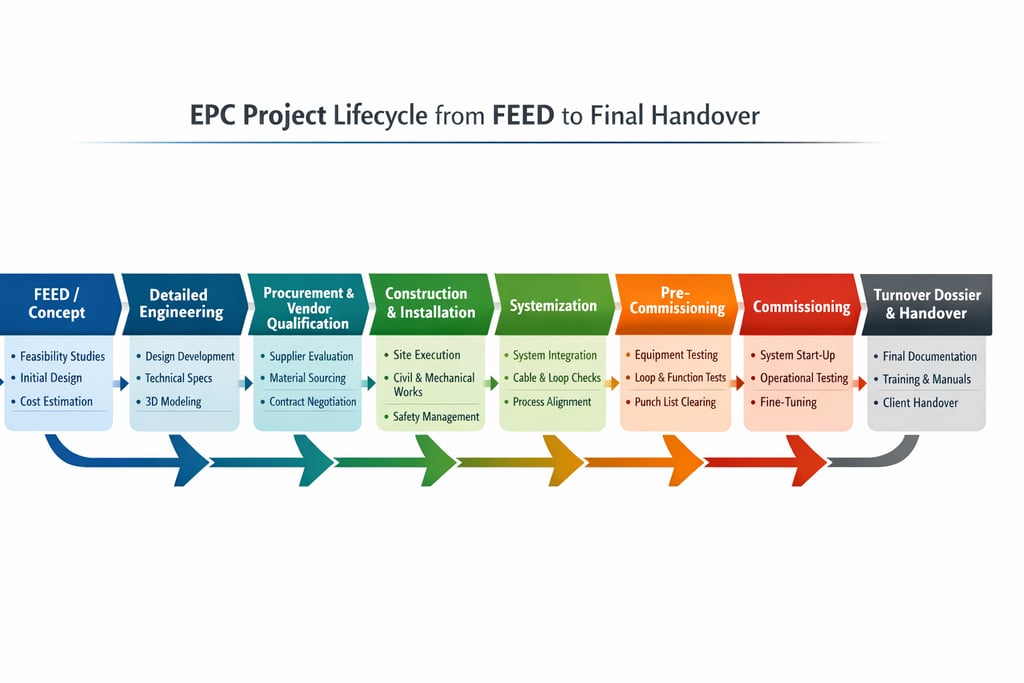
What engineering usually includes
Engineering can range from concept to detailed design.
Common deliverables include:
Basis of design and design calculations
FEED support or full detailed engineering
3D model and layout drawings for constructability
Process, mechanical, piping, electrical, instrumentation, civil, and structural design
Specs, datasheets, and material requisitions
Inspection and test plans tied to quality hold points
If your project is process heavy (oil and gas, petrochemicals, power, water treatment), your EPC partner’s engineering depth matters more than their marketing.
What procurement actually means
Procurement is not just purchasing.
It includes:
Approved vendor lists and vendor qualification
RFQs, technical bid evaluation, and commercial negotiation
Expediting and inspection planning
Logistics planning, customs documentation, and delivery sequencing
Spares, special tools, and preservation for long lead equipment
Good procurement is schedule control in disguise. One late critical item can stall mechanical completion across multiple systems.
What construction and commissioning typically cover
Construction covers site works and installation. Commissioning is where you learn if the design and build were truly integrated.
Expect EPC scope to include:
Civil works and foundations
Steel structure fabrication and erection
Mechanical installation, piping, welding, and testing
Electrical installation and energization readiness
Instrument loops, control systems, and functional testing
Pre commissioning, commissioning, and performance testing
Turnover dossiers and as built documentation
If an EPC company cannot explain how they manage commissioning and handover documentation, that’s a red flag.
Why hire an EPC contractor in UAE for a global project
You hire an EPC contractor in the UAE when you want integrated project delivery, access to established supply chains, and a contractor ecosystem familiar with large energy, industrial, and infrastructure work. UAE based EPC contractors are often used for projects across the Middle East, Africa, and Asia because the UAE is a logistics hub with strong contracting and procurement capacity.
A big reason buyers look at the UAE is practical, not symbolic. Projects need equipment, skilled supervision, reliable subcontractors, and predictable logistics. The UAE is positioned to support that kind of execution.
What you usually gain with a UAE based EPC approach
Consolidated engineering and procurement control
Access to regional fabrication and global vendors
Project management teams used to multi package delivery
Familiarity with international standards used in energy and industrial work
Logistics routes through major UAE ports for heavy cargo and modular shipments
None of this guarantees success. It just improves your odds when you also run a disciplined tender, contract, and governance process.
Which projects EPC construction companies in UAE typically deliver
EPC construction companies in UAE commonly deliver oil and gas facilities, petrochemicals, power plants, renewable energy, desalination and water treatment, substations, transmission work, and industrial plants. Many firms also support infrastructure packages that interface with utilities and heavy civil works.
To match the right contractor to your needs, think in terms of “project DNA,” not just sector labels.
Oil and gas and petrochemicals
Typical EPC scopes include:
Gas processing and compression facilities
Storage terminals and tank farms
Pipelines and associated stations
Refinery units and brownfield tie ins
Utilities and offsites, flare systems, and control buildings
Brownfield work deserves special attention. Shutdown planning, tie in windows, and interface management often decide the schedule.
Power generation and grid works
Common EPC work includes:
Combined cycle and simple cycle power plant packages
Balance of plant scope and utilities integration
Substations and switchyards
Transmission line works and grid interconnections
Control systems integration and protection schemes
For grid related projects, battery limits and interface scope must be painfully clear, or you will fight over responsibility later.
Renewable energy
Many EPC firms also support:
Solar PV plants and related substations
Utility scale electrical infrastructure and SCADA
Civil works, piling, and balance of plant
Renewables look “simple” until you handle grid compliance, commissioning sequencing, and warranty boundaries across multiple vendors.
Water and desalination
EPC scopes often include:
Desalination plants and intake and outfall works
Pump stations and distribution interfaces
Wastewater treatment facilities
Chemical dosing systems and instrumentation
Water projects live or die by commissioning readiness and water quality performance testing. Your contract needs clear acceptance criteria.
Industrial plants and manufacturing
You may see EPC applied to:
Cement, steel, and heavy industry
Food and beverage plants with utilities upgrades
Warehousing and industrial buildings with complex MEP systems
Process skids and modular packages integrated into facilities
If your project is “industrial but not energy,” check whether the EPC firm’s strength is process integration or mainly construction management.
How do you choose the best EPC construction company in UAE
Choose an EPC construction company in UAE by matching proven sector experience, engineering depth, procurement capability, construction execution, safety culture, financial strength, and commissioning discipline to your project. Then validate proof through documents, references, and governance readiness, not slogans.
A strong EPC contractor is not “the biggest.” It is the one that fits your project profile, contract model, and risk appetite.
Start with fit before reputation
Ask yourself:
Is this a greenfield build or a brownfield tie in
Is the scope process heavy or mainly civil and MEP
Are there long lead items that can break the schedule
Do you need modularization and fabrication support
Do you need performance guarantees and acceptance testing
Your answers determine which contractors you should even invite to bid.
What to request in a serious prequalification pack
If you want to avoid brochure claims, ask for proof that is normal in EPC procurement:
Organization chart showing engineering and project controls
List of completed similar projects with scope and role
Safety management system overview and recent HSE metrics with definitions
Quality management system and sample inspection and test plans
Audited financial statements or other accepted proof of financial capacity
Construction execution plan and subcontracting strategy
Commissioning approach and sample turnover dossier index
You do not need to publish these documents. You need to use them to confirm capability.
What I suggest you look for in early conversations
I like to test EPC maturity with simple questions that reveal real execution thinking:
How do you lock scope and manage change without choking progress
What is your long lead procurement plan and expediting method
How do you control interfaces between packages and subcontractors
What is your system completion and commissioning sequence
How do you define mechanical completion and handover boundaries
If answers stay vague, it usually stays vague during delivery too.
How does EPC prequalification and vendor registration work in the UAE market
Many large owners and government linked entities use structured prequalification and approved vendor processes before allowing EPC contractors to bid. You should treat prequalification as a buyer due diligence phase, where you verify engineering depth, HSE systems, quality controls, financial capacity, and relevant project delivery history.
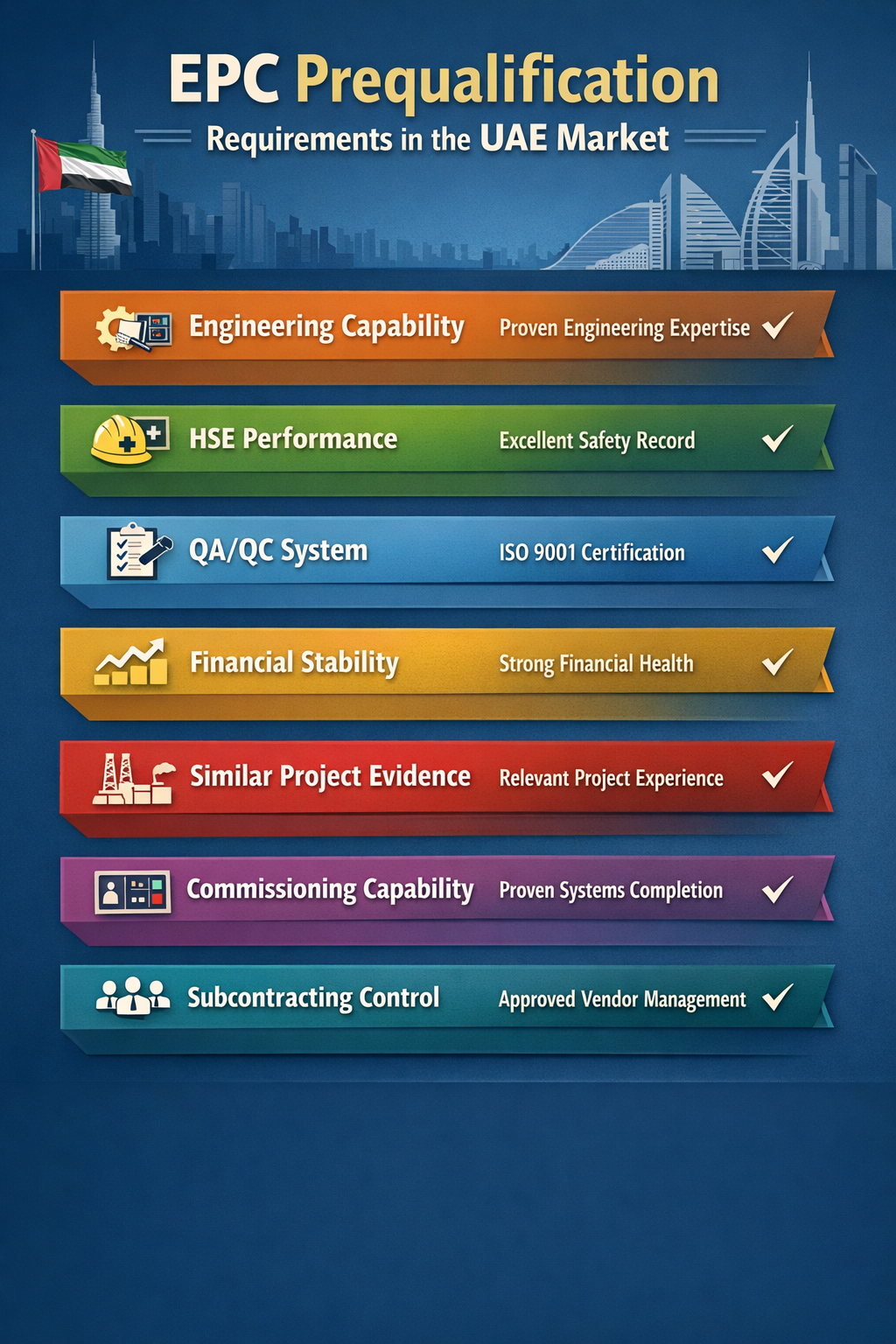
In the UAE and wider GCC market, prequalification is often as important as price. Some buyers will not open your bid if you are not registered or not approved for the right scope category.
What buyers commonly screen during prequalification
Scope relevance and similar project experience
QA QC systems and inspection discipline
HSE systems and site safety culture
Resource capacity, including key staff CVs
Financial stability and bonding capacity
Supply chain strength and vendor management
Past performance, claims history, and governance maturity
This does not mean every buyer uses the same checklist. But the themes repeat across energy, utilities, and industrial owners.
How you can use prequalification to protect your project
Instead of treating prequal as paperwork, use it to reduce delivery risk:
Ask for sample system completion methodology and commissioning plans
Ask how they handle brownfield tie ins and shutdown windows
Ask which parts they self perform and which they subcontract
Ask how they control welding quality, NDT, and pressure testing readiness
Ask how they manage documentation, not just construction
If the EPC contractor pushes back on transparency, that is useful information.
What is the difference between EPC and EPCM and which should you choose
EPC puts delivery responsibility on the contractor, often under a lump sum turnkey model. EPCM means the contractor manages engineering and procurement and oversees construction, while you retain more cost and schedule risk. Choose EPC when you want single point responsibility and clear performance obligations, choose EPCM when you want more control and can manage risk.
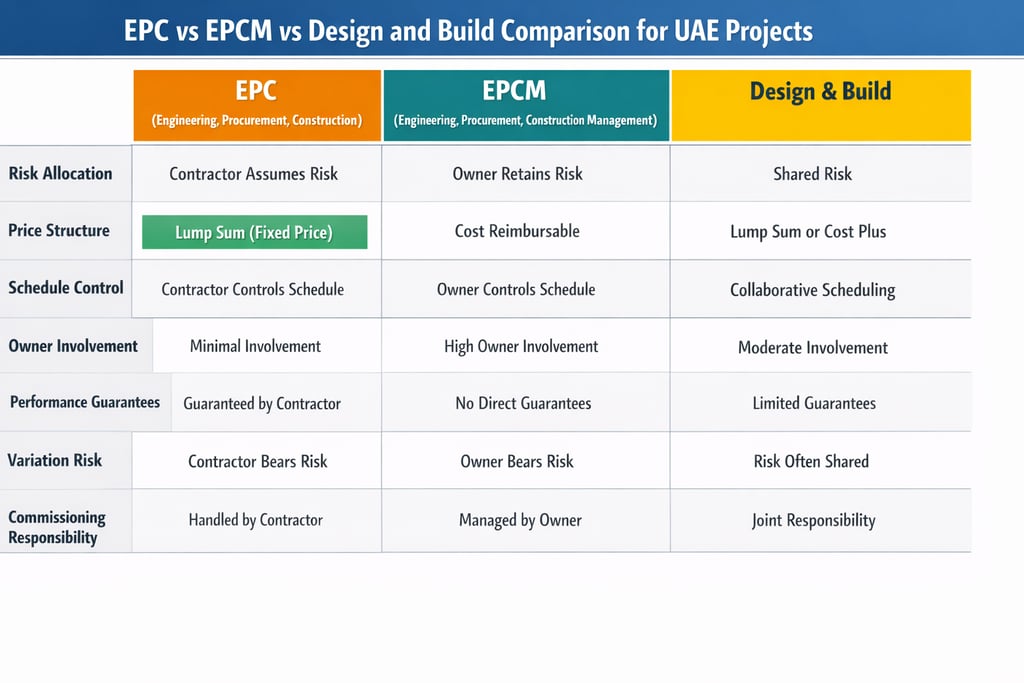
This choice shapes everything else, including pricing, governance, staffing, and dispute risk.
When EPC is usually the better fit
You want firm performance testing and acceptance criteria
You need a defined completion date and LD structure
You want one contract and one integration owner
You cannot dedicate a large in house delivery team
EPC is not “hands off.” You still need governance. But the risk allocation is clearer.
When EPCM can make more sense
Scope is uncertain and likely to evolve
You want to select key equipment vendors directly
You have strong owner engineering and project management capability
You prefer reimbursable construction with tight controls
EPCM can be flexible, but flexibility can turn into scope creep if your controls are weak.
What contract models do EPC construction companies in UAE offer
Common contract models include lump sum turnkey, design and build, EPC with reimbursable elements, and EPCM. The model you choose affects risk allocation, how variations are handled, what guarantees apply, and how disputes are resolved.
Terms vary by project, but these are the patterns you will see.
Lump sum turnkey and LSTK style EPC
In a lump sum turnkey approach, the contractor commits to deliver a working facility for an agreed price and schedule, subject to contract terms and change control. Buyers like LSTK because it can simplify interfaces and create a single accountability line.
You should still define:
Battery limits and scope boundaries
Exclusions and client supplied items
Acceptance testing and performance guarantees
Document requirements for handover
Variation rules and schedule impact rules
Design and build for industrial and infrastructure scope
Design and build can work well when:
The facility is less process intensive
The scope is mostly civil, structural, and MEP
Performance guarantees are simpler
Be careful if you have hidden process complexity. Design and build can under price the engineering and commissioning effort.
EPCM or hybrid models
Hybrid models are common when buyers want EPC like outcomes but with direct control of major equipment. If you do this, be strict about interfaces. Split packages multiply interface risk.
Which EPC contract clauses matter most when you are the buyer
The most important EPC contract clauses define performance testing, acceptance criteria, liquidated damages, warranty and defects liability, change control, payment milestones, security instruments, and dispute resolution. These clauses turn a nice scope statement into a project that can be delivered and defended.
This is where many buyers lose leverage. They negotiate prices hard, then keep the contract loose. Later they fight over “what was included.”
Performance guarantees and acceptance tests
Spell out:
What tests are required
Who supplies test media and utilities
Test duration and pass fail criteria
What happens if performance is missed
How re testing works and who pays
If acceptance tests are vague, handover becomes a negotiation, not a milestone.
Liquidated damages for delay and performance
LD clauses should:
Tie to defined completion points
Avoid double counting the same failure
Define caps and exclusions
Connect to schedule logic, not just calendar days
Do not rely on LDs as a plan. Use them to protect you if the plan fails.
Change orders and variation valuation
Most EPC disputes come from change.
Define:
What counts as a change
Notice requirements and timelines
How time impact is assessed
How daywork or rate schedules apply
What documentation is needed for approval
A clean variation process reduces claims because it reduces ambiguity.
Warranty, defects liability, and spares
Decide what you need for reliable operations:
Warranty periods for equipment and workmanship
Defects liability terms and response times
Critical spares and consumables lists
Special tools and vendor support requirements
If your plant cannot run without spares, make them part of the contract, not an afterthought.
Security instruments and parent company support
Depending on the project, you may require:
Performance bond
Advance payment guarantee
Retention or retention bond
Parent company guarantee where relevant
These tools help manage counterparty risk, but they are not substitutes for capability checks.
How do you run an EPC tender that attracts good bids and avoids scope gaps
A strong EPC tender starts with a tight scope definition, clear battery limits, documented assumptions, and a bid evaluation method that compares like for like. You should issue technical requirements, quality and HSE expectations, commissioning requirements, and document deliverables upfront, then enforce a structured RFI and clarification process.
If you want better bids, you have to make it easier to bid correctly.
Build an RFP package that reduces ambiguity
Your tender set should include:
Scope of work with battery limits and interfaces
Design basis and applicable codes and standards
Site data, utilities availability, and constraints
Required deliverables and document register
Quality requirements and inspection hold points
HSE requirements and site rules
Commissioning philosophy and acceptance tests
Milestone definitions and payment structure
Vague RFPs invite low bids that later rely on variations.
Set bidder instructions that protect comparability
Ask bidders to submit:
Execution schedule with logic, not just dates
Long lead procurement list and delivery plan
Staffing plan and key roles
Subcontracting strategy and control approach
Assumptions and exclusions register
Commissioning plan and system completion approach
Then force a “no hidden assumptions” rule. If something matters, it must appear in their assumptions register.
Use a two stage clarification process
Stage one clarifies scope and technical alignment before commercial finalization. Stage two locks terms, clarifies exceptions, and resolves interface questions.
This keeps you from discovering major differences after you pick the lowest price.
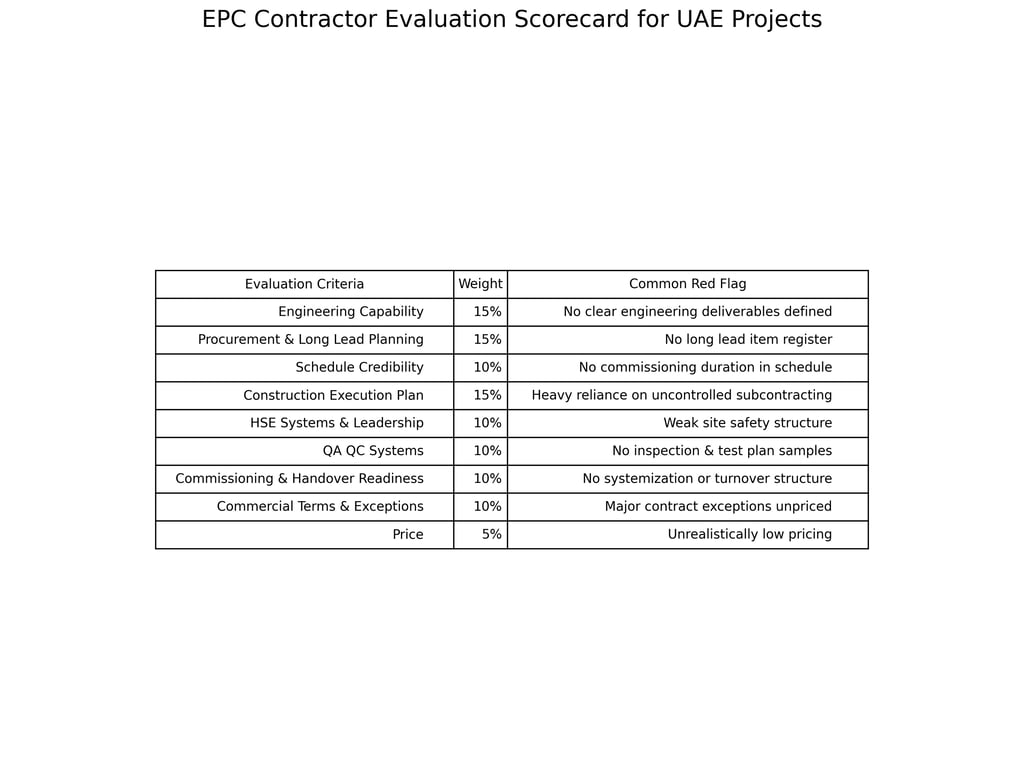
How do you compare EPC contractors in UAE with a scorecard you can actually use
Compare EPC contractors using a weighted scorecard that balances technical delivery risk and commercial value. Include engineering depth, procurement realism, schedule credibility, HSE performance systems, quality controls, commissioning readiness, governance maturity, and price, then validate high impact claims with proof documents.
You can adapt.
Step one set the evaluation buckets
Use buckets that match real project failure points:
Technical solution and compliance
Engineering capability and constructability thinking
Procurement plan and long lead risk control
Schedule quality and critical path credibility
Construction execution plan and subcontract control
HSE system maturity and site safety leadership
QA QC system and inspection discipline
Commissioning and handover readiness
Commercial terms and contract exceptions
Price and payment profile
Step two ask for evidence not adjectives
For each bucket, define what evidence earns a higher score, for example:
Engineering includes discipline leads and sample deliverables
Procurement includes long lead list and expediting plan
Schedule includes logic linked milestones and productivity assumptions
QA QC includes ITP samples and test pack approach
Commissioning includes systemization plan and turnover dossier index
Step three apply red flag rules
Some issues should trigger deeper review:
A schedule that shows no commissioning time
Unpriced contract exceptions on core clauses
An assumption list that hides major scope exclusions
A procurement plan that ignores inspection and expediting
A subcontracting approach with no controls or quality gates
Price matters. But price without execution credibility is just a number.
What should you ask an EPC construction company in UAE before you sign
Before signing, ask how the contractor will manage interfaces, long lead procurement, quality control, safety leadership, system completion, commissioning, document handover, and change control. You want to hear a method, not a promise.
Use questions that force operational detail.
Engineering and design control questions
How will you control design changes after IFC release
What is your constructability review process
How do you manage vendor data and drawing integration
How do you control clashes and site queries
Procurement and logistics questions
What are the long lead items and your expediting plan
How do you qualify vendors and manage inspections
How do you manage preservation and storage for sensitive equipment
How do you sequence deliveries to match installation needs
Construction and quality questions
What is your welding and NDT control approach
How do you manage test packs and pressure testing
How do you ensure punch lists do not explode near handover
How do you manage subcontractor quality and supervision
Commissioning and handover questions
What is your system completion and system handover method
How do you define mechanical completion per system
What does your turnover dossier include
How do you plan performance tests and client witnessing
A contractor that answers these cleanly is usually prepared. A contractor that dodges them is telling you something.
How do EPC construction companies in UAE manage procurement and long lead risks
Strong EPC contractors manage long lead risk through early vendor engagement, realistic procurement schedules, expediting, inspection planning, and logistics sequencing that matches construction milestones. They also use clear vendor data control to avoid late drawing revisions that disrupt fabrication and installation.
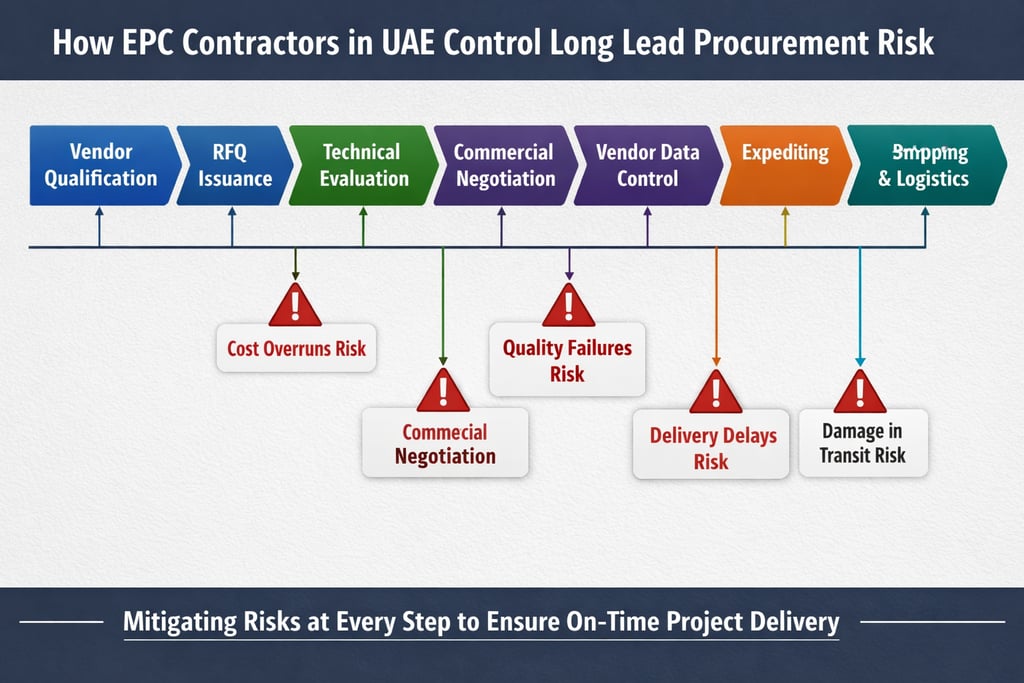
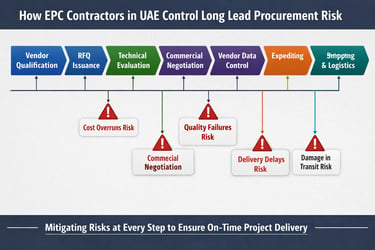
This is one of the biggest reasons EPC projects slip.
What good long lead control looks like
A long lead register tied to the master schedule
Clear vendor data milestones with consequences
Factory acceptance test planning early, not late
Shipping plans for heavy lifts and route surveys where needed
Preservation procedures for equipment sitting on site
If the EPC bid lacks these, the schedule is likely optimistic.
How to protect yourself as the buyer
You can require:
Monthly procurement status reporting with evidence
Expediting and inspection plans for critical equipment
Defined delivery windows tied to installation readiness
Right to audit vendor and fabrication progress where reasonable
You are not micromanaging. You are reducing surprises.
How do EPC construction companies in UAE handle HSE and QA QC on complex sites
EPC contractors manage HSE and quality through formal management systems, site leadership routines, permit to work controls, inspection and test planning, and documented hold points. Mature contractors integrate HSE and QA QC into planning and supervision, rather than treating them as separate departments.
Safety and quality are daily behaviors, not policy documents.
What to look for in HSE maturity
Site safety leadership structure and clear accountability
Permit to work and isolation controls for high risk activities
Toolbox talks and pre task risk assessments that are not copy paste
Incident learning systems and corrective action tracking
What to look for in QA QC maturity
Inspection and test plans aligned to codes and client specs
Material traceability for critical items
Weld mapping, NDT planning, and hydrotest readiness control
Test packs and dossiers that build as you build, not at the end
When QA QC is late, turnover documentation becomes a scramble, and handover becomes a negotiation.
Why commissioning and handover documentation can decide whether your EPC project succeeds
Commissioning and handover succeed when system completion is planned from the start, acceptance tests are defined, and turnover dossiers are built progressively. Poor documentation and late systemization cause delays, safety risk, and operational headaches after handover.
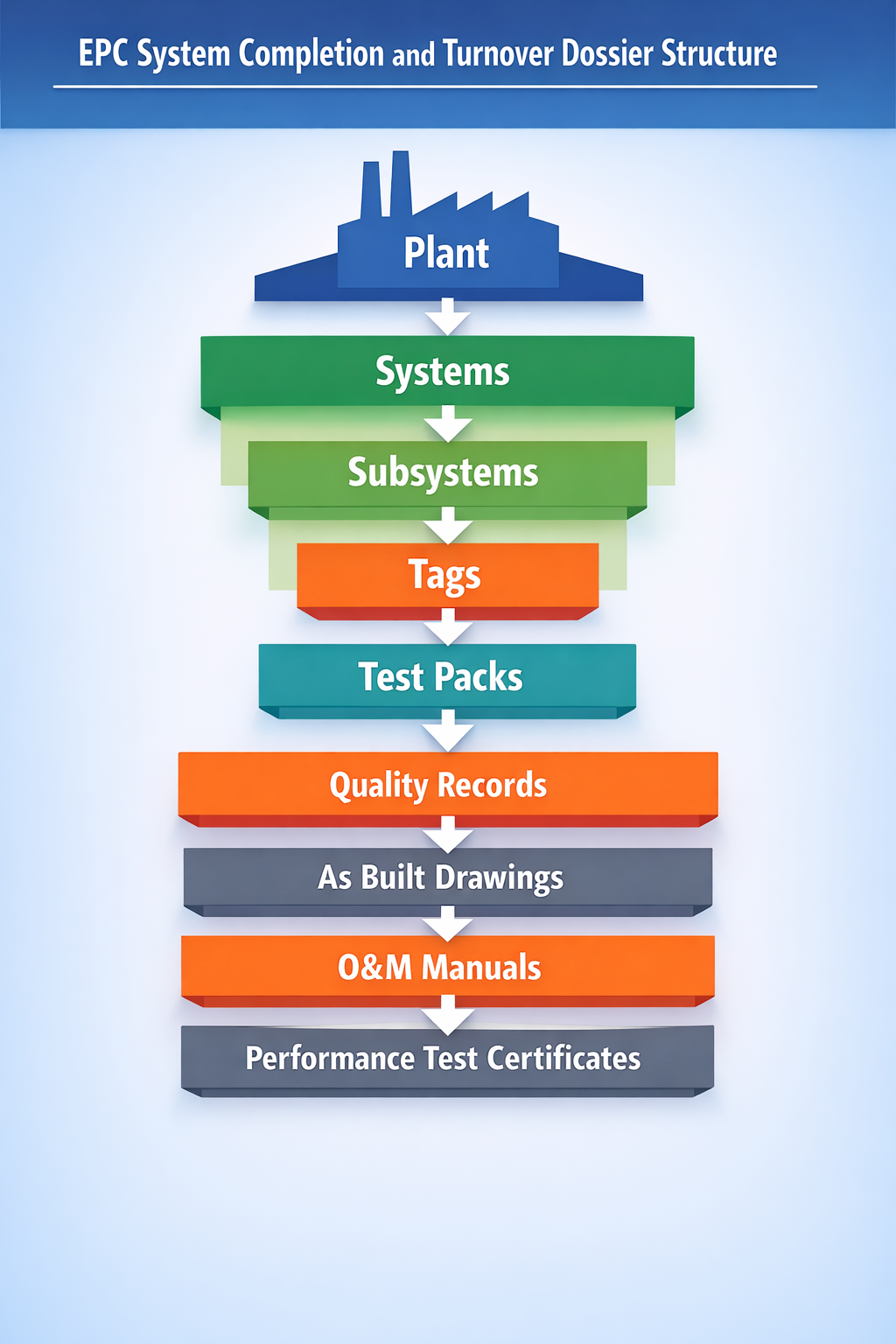
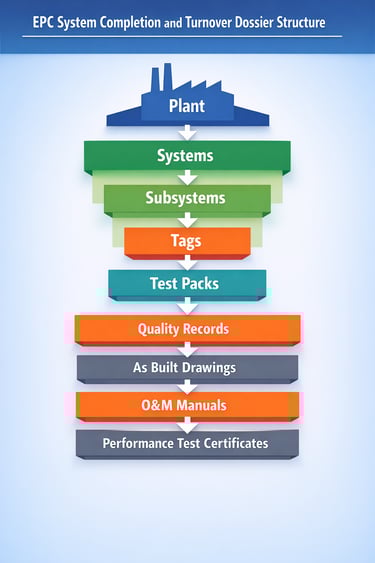
This is where many EPC projects “finish” on paper but fail in operations.
What a complete turnover package often includes
Your contract can require a structured turnover dossier per system:
As built drawings and redline reconciliation
Quality records, material certificates, and inspection reports
Pressure test and flushing records where applicable
Electrical test results and loop checks
Functional test records and cause and effect verification if relevant
O&M manuals, vendor documentation, and training records
Spares, special tools, and warranty certificates
Punch list closure evidence and handover certificates
The exact list depends on the sector, but the idea is the same. If it is not documented, it is not complete.
How to reduce end of project chaos
Require:
Systemization plan early
System boundaries and tag naming alignment
Progressive dossier completion targets
Clear definitions for mechanical completion, ready for commissioning, and ready for start up
This protects your start up schedule and your operations team.
Which terms and acronyms should you understand when buying EPC in UAE
Buyers should understand common EPC terms like LSTK, FEED, IFC, battery limits, systemization, mechanical completion, punch lists, and performance testing. These terms appear in bids, contracts, and site reporting, and misunderstanding them creates scope gaps.
Here is a simple glossary you can skim.
Core EPC buying terms
FEED Front end engineering design that defines scope and improves cost certainty
IFC Issued for construction drawings that guide site work
LSTK Lump sum turnkey pricing approach where scope and risk allocation matter
Battery limits The defined physical and scope boundary of the EPC work
Interface The boundary between packages, vendors, and contractors
Systemization Breaking the plant into systems for completion and commissioning
Mechanical completion Installation complete per defined criteria, ready for commissioning steps
Punch list Items remaining to close before acceptance, often tracked by category
Performance test Contract defined tests that confirm output, efficiency, or quality targets
Turnover dossier The documentation bundle required for handover and operations readiness
If you want fewer disputes, put these definitions in your contract.
Which EPC construction companies in UAE should you shortlist and how do you build the shortlist safely
A safe shortlist is built by matching contractor type to your project and then verifying capability through prequalification proof, project references, and bid quality, rather than relying on generic top company lists. Shortlist by category, then validate fit through evidence and site level execution planning.
Many searchers want a list of names. The problem is that lists are rarely specific to your scope, contract model, and risk profile. A “top EPC companies in UAE” list can be a starting point, but it should never be your selection method.
Step one shortlist by contractor category
Instead of chasing a single “best,” shortlist by category:
Oil and gas process EPC contractors
Best for gas, hydrocarbons, complex piping, rotating equipment, and hazardous area controls.
Power and grid focused EPC contractors
Best for substations, transmission interfaces, protection systems, and energization readiness.
Water and utilities EPC contractors
Best for desalination, pumping networks, and water quality acceptance regimes.
Industrial and MEP heavy EPC contractors
Best for manufacturing facilities, utilities upgrades, and complex building services.
This approach helps you avoid inviting the wrong bidders.
Prime Star Engg operates as an EPC construction company in the UAE with a focus on disciplined engineering, controlled procurement, and structured site execution. The company approaches projects with clear scope definition, system based completion planning, and documented quality controls. Its strength lies in coordinating engineering, vendor management, and construction supervision in a way that supports predictable delivery and clean handover.
Step two validate with proof that can be checked
Ask for:
Similar project list with scope description and completion stage
Key personnel CVs and role clarity
Commissioning approach and sample system handover structure
Procurement long lead plan for your specific equipment types
Contract exception list early, not after selection
Step three use a bid quality test
A serious EPC bidder can submit:
A coherent schedule with logic
A realistic procurement plan
A commissioning sequence
A clean assumptions and exclusions register
If a bidder cannot do this, they are not ready for your project, even if their brand is famous.
Frequently asked questions about EPC construction company in UAE
What is the fastest way to evaluate an EPC company in UAE
Start with prequalification documents, then test bid quality. Look for a schedule with logic, a long lead procurement plan, and a commissioning and handover method. If those are weak, the delivery risk is high regardless of the company name.
Is an EPC contractor the same as a construction company in UAE
Not always. A construction company may focus mainly on site execution, while an EPC contractor integrates engineering, procurement, construction, and often commissioning under one delivery model. If you need process integration and performance tests, EPC capability matters.
Can an EPC construction company in UAE handle projects outside the UAE
Many can, but you should confirm how they manage local permitting, subcontractor sourcing, logistics, and site supervision in your target country. Ask for examples of similar delivery environments and request an execution plan tailored to your location.
What should be included in an EPC turnkey contract
At minimum, include defined scope boundaries, deliverables, schedule milestones, quality and HSE requirements, acceptance tests, change control rules, warranty terms, and security instruments where needed. Also include clear definitions for mechanical completion, commissioning readiness, and handover documentation.
How do I avoid scope gaps in an EPC tender
Make battery limits and interfaces explicit, require an assumptions and exclusions register, and force bidders to price the same deliverables and acceptance tests. Then run structured clarifications before final commercial evaluation.
Closing thoughts
Use the shortlist method, the tender playbook, and the bid scorecard in this guide. Then insist on proof, not promises. When you do that, you will choose an EPC construction company in UAE that fits your project, and you will also build a page that search engines and AI systems can quote safely.

Is a leading construction company in the UAE, delivering 100% results-driven solutions across the Energy and Industrial sectors. We empower a rapidly growing UAE to reach new heights.
call us
Tel: +971-25656302
Mail Us
Quick Links