we are successfully executing projects in uae
Explore Our Engineering and Design Capabilities
Build with clarity, precision, and real engineering expertise
From early concept planning to final execution, Prime Star General Maintenance delivers integrated engineering and design capabilities that help you move from idea to reality with confidence.
Trusted by businesses seeking dependable, well-executed engineering solutions across multiple industries.
Most projects don’t fail because of lack of effort. They fail because the foundation wasn’t properly designed.
Whether you are building, upgrading, or maintaining infrastructure, the quality of engineering and design directly impacts cost, performance, and long-term reliability.
What Engineering and Design Capabilities Really Mean
Engineering and design capabilities refer to the ability to plan, model, test, and execute technical solutions that meet functional, safety, and operational requirements. These capabilities combine technical expertise, tools, and structured processes.
At a basic level, engineering defines how something works. Design defines how it is structured and built.
But in real-world projects, these roles overlap heavily. A strong capability means the team can:
Translate ideas into workable technical plans
Identify risks before construction begins
Optimize systems for cost, durability, and performance
Align design with real-world constraints
For example, designing a facility layout is not just about placing equipment. It involves load calculations, workflow efficiency, maintenance access, and compliance standards.
This is where integrated engineering and design become valuable. Instead of isolated tasks, everything works together.
Our Core Engineering and Design Services
Prime Star General Maintenance offers a full range of engineering and design services, including conceptual planning, technical drafting, system design, structural coordination, and project execution support.
The goal is to support projects from early-stage ideas to implementation.
1. Concept Development and Feasibility
Before any design begins, you need clarity on what is possible.
This stage includes:
Requirement analysis
Site and condition assessment
Initial cost and feasibility evaluation
Risk identification
It helps prevent costly mistakes later.
2. Technical Design and Drafting
Once the concept is validated, detailed design begins.
This includes:
2D and 3D drawings
Layout planning
System schematics
Equipment positioning
These documents serve as the blueprint for execution.
3. System Design and Integration
Engineering systems must work together, not independently.
Key areas include:
Electrical system design
Mechanical layouts
Plumbing and utility coordination
HVAC planning
A well-integrated system reduces inefficiencies and long-term maintenance issues.
4. Structural and Technical Coordination
Design is not complete until it aligns with structural realities.
This stage ensures:
Load considerations are addressed
Materials are suitable
Design matches site conditions
Safety standards are followed
It bridges the gap between design and real-world application.
5. Execution Support and Optimization
Design alone is not enough.
Prime Star provides:
On-site coordination
Design adjustments during execution
Troubleshooting support
Performance optimization
This ensures the final outcome matches the original intent.
Why Integrated Engineering and Design Matters
Integrated engineering and design improve project efficiency, reduce errors, and ensure better alignment between planning and execution, resulting in cost savings, improved performance, and fewer delays.
Many projects suffer from disconnects between design and execution.
For example:
Designs that ignore installation constraints
Systems that conflict with each other
Underestimated material or load requirements
An integrated approach solves this by aligning all disciplines early.
Key Benefits
Fewer design revisions
Better cost control
Faster project timelines
Improved system reliability
This is especially important for complex or multi-phase projects.
How Our Engineering Process Works
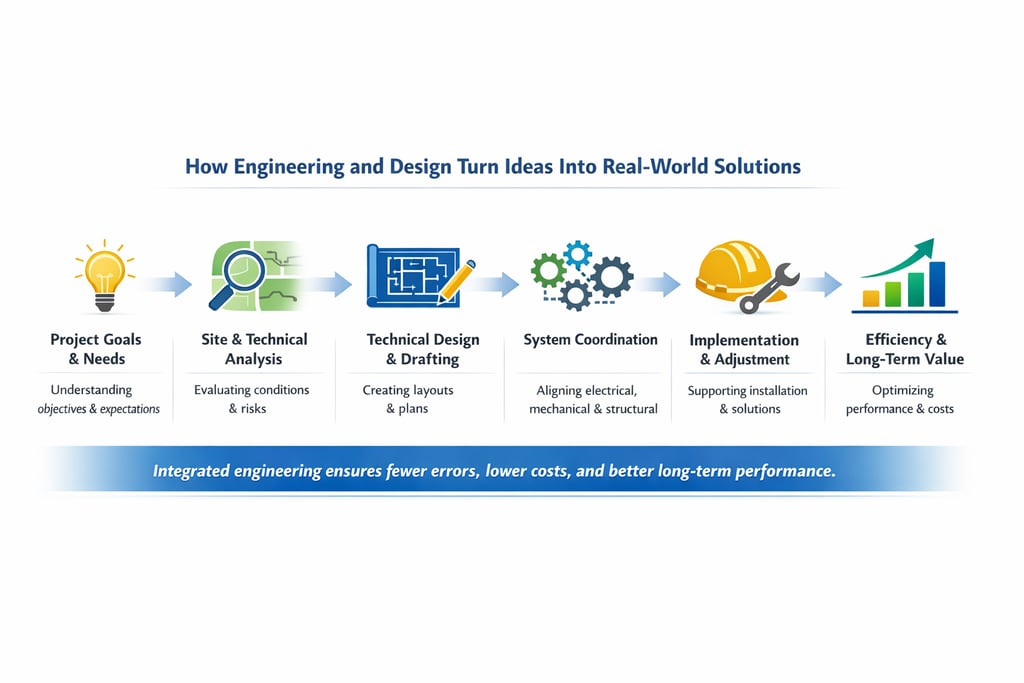
Prime Star follows a structured engineering workflow that includes discovery, planning, design, validation, and execution support to ensure accuracy, efficiency, and project success.
Step 1: Requirement Discovery
Everything starts with understanding your needs.
This includes:
Project goals
Functional requirements
Budget constraints
Timeline expectations
Clear input leads to better output.
Step 2: Site and Technical Assessment
We analyze real-world conditions.
This may include:
Site measurements
Environmental factors
Existing systems
Operational constraints
This step prevents unrealistic designs.
Step 3: Concept and Design Development
Initial concepts are translated into workable designs.
This stage includes:
Layout planning
System selection
Preliminary calculations
You get a clear view of how the project will function.
Step 4: Detailed Engineering
Designs are refined into execution-ready documents.
Deliverables may include:
Technical drawings
Specifications
Material requirements
Installation guidelines
These documents guide implementation.
Step 5: Review and Validation
Before execution, designs are reviewed for:
Accuracy
Compliance
Feasibility
Adjustments are made where necessary.
Step 6: Execution Support
During implementation, we stay involved.
This includes:
Coordination with contractors
Design clarifications
Problem-solving on-site
This ensures smooth delivery.
Industries We Support
Prime Star General Maintenance supports multiple industries, including construction, commercial facilities, industrial operations, and infrastructure projects, providing adaptable engineering and design solutions tailored to each sector’s needs.
Different industries have different requirements.
Construction and Infrastructure
Structural planning
Utility integration
Site layout design
Commercial Facilities
Office and workspace planning
HVAC and electrical systems
Maintenance-friendly design
Industrial Operations
Equipment layout optimization
Workflow efficiency
Safety compliance
Maintenance and Upgrades
Retrofit designs
System improvements
Performance upgrades
What Sets Our Capabilities Apart
Prime Star’s engineering and design capabilities stand out through practical experience, integrated workflows, and a focus on real-world execution rather than theoretical design alone.
Many engineering services stop at drawings.
The difference here is execution awareness.
Key Differentiators
1. Practical Design Thinking
Designs are created with installation and maintenance in mind.
2. Cross-Discipline Coordination
Electrical, mechanical, and structural elements are aligned early.
3. Scalable Solutions
Designs consider future expansion and upgrades.
4. Problem-Solving Approach
Unexpected challenges are addressed proactively.
How Good Design Reduces Long-Term Costs
Well-planned engineering and design reduce long-term costs by minimizing errors, improving efficiency, and preventing system failures, leading to lower maintenance expenses and better overall performance.
Poor design often leads to hidden costs.
These may include:
Frequent repairs
Energy inefficiencies
System downtime
Expensive redesigns
Good design focuses on prevention.
Examples
Proper load calculation prevents structural stress
Efficient layouts reduce operational delays
Correct material selection improves durability
Over time, these decisions significantly reduce expenses.
When You Should Invest in Professional Engineering Design
You should invest in professional engineering and design when planning new projects, upgrading systems, solving recurring issues, or improving efficiency and scalability.
You don’t need engineering support only for large projects.
It becomes critical when:
Starting a new build or installation
Expanding existing infrastructure
Experiencing recurring technical problems
Trying to improve performance or efficiency
Early involvement leads to better outcomes.
Common Mistakes in Engineering and Design Projects
Common mistakes include skipping feasibility analysis, ignoring site conditions, poor coordination between systems, and underestimating long-term maintenance requirements.
These issues often lead to delays and increased costs.
Key Mistakes
Designing without real-world constraints
Overlooking integration between systems
Choosing materials based only on cost
Lack of documentation
Avoiding these mistakes improves both project success and long-term value.
Frequently Asked Questions
What industries benefit most from engineering and design services?
Industries like construction, manufacturing, commercial facilities, and infrastructure benefit the most. These sectors rely on accurate planning and system integration to ensure safety, efficiency, and long-term performance.
How long does the engineering design process take?
The timeline depends on project complexity. Small projects may take a few days, while larger or multi-system designs can take weeks due to detailed planning, validation, and coordination requirements.
Can design be modified during project execution?
Yes, design adjustments can be made during execution if conditions change or improvements are identified. However, early planning reduces the need for major modifications later.
What is the difference between design and engineering?
Design focuses on structure and layout, while engineering ensures functionality, safety, and performance. In practice, both work together to create complete and reliable solutions.
How do I know if my project needs professional engineering support?
If your project involves technical systems, safety considerations, or long-term performance requirements, professional engineering support helps reduce risks and improve outcomes.
Every successful project starts with the right foundation.
If you are planning a new build, upgrading an existing system, or trying to solve ongoing issues, the right engineering and design approach can save time, reduce costs, and improve results.
To discuss your project requirements and explore how our engineering and design capabilities can support your next step.
Clear planning. Practical design. Reliable execution.
Is a leading construction company in the UAE, delivering 100% results-driven solutions across the Energy and Industrial sectors. We empower a rapidly growing UAE to reach new heights.
call us
Tel: +971-25656302
Mail Us
Quick Links
Contact Us
Powered by MSGDigitals.com