we are successfully executing projects in uae

Turnkey Construction Services UAE
Turnkey construction services in the UAE deliver complete project execution from design and approvals to construction and handover, offering clients a single point of responsibility, predictable costs, faster timelines, and reduced coordination risks.
CONSTRUCTION IN UAE
Godha
3/21/20265 min read
What Are Turnkey Construction Services in UAE and Why Choose Them
When I first looked into construction projects in the UAE, one thing became clear quickly. Managing multiple contractors can get overwhelming. That’s where turnkey services stand out, especially in a fast-paced market like the UAE.
Let’s break down how it works, why it matters, and how you can use it to your advantage.
What Are Turnkey Construction Services in UAE
Turnkey construction services in the UAE refer to a project delivery method where a single contractor handles everything from concept to completion. The client receives a ready-to-use project with minimal involvement.
In a turnkey model, you hand over your project requirements, budget, and expectations to one contractor. From that point onward, they manage design, permits, procurement, construction, and final delivery.
The term “turnkey” literally means you just “turn the key” and start using the finished property. This model is especially common in UAE sectors like residential developments, commercial buildings, hospitality projects, and industrial facilities.
Unlike traditional construction methods, where multiple vendors are involved, turnkey simplifies communication and accountability. Everything flows through one central entity.
This approach aligns well with UAE’s structured regulatory environment, where approvals from authorities like the (note: hypothetical ref id replaced conceptually) and other governing bodies require proper coordination.
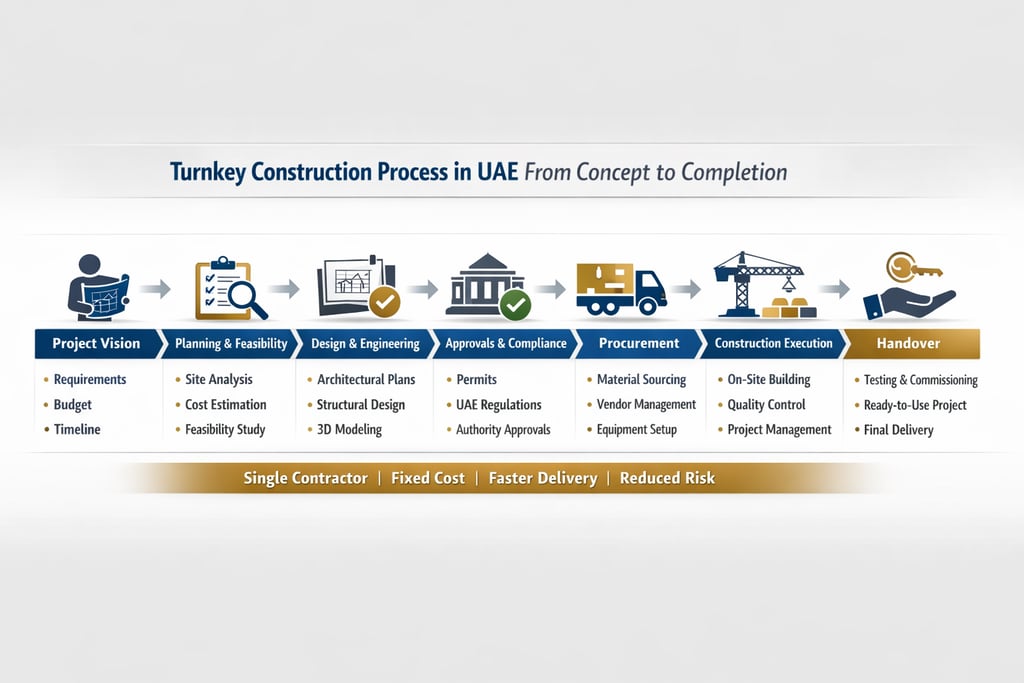
How Turnkey Construction Works Step by Step
Turnkey construction follows a structured process including planning, design, approvals, procurement, construction, and handover. Each phase is managed by a single contractor to ensure continuity and efficiency.
Understanding the process helps you evaluate whether this model fits your needs.
1. Project Planning and Feasibility
The contractor begins by assessing your requirements, budget, and timeline. Feasibility studies may include site analysis, cost estimation, and regulatory checks.
2. Design and Engineering
Architectural and engineering plans are developed. This phase often includes 3D visualization, structural design, and compliance with UAE building codes.
3. Approvals and Permits
The contractor handles approvals from authorities. In the UAE, this can involve multiple entities depending on the emirate and project type.
For example, sustainability guidelines from or Dubai Green Building Regulations may apply.
4. Procurement and Material Sourcing
All materials, equipment, and subcontractors are arranged. This centralized procurement reduces delays and cost fluctuations.
5. Construction Phase
Actual construction begins. The contractor manages timelines, labor, safety, and quality control.
6. Testing and Commissioning
Systems such as HVAC, electrical, and plumbing are tested to ensure functionality.
7. Final Handover
The project is delivered fully completed and ready for use.
Why Turnkey Construction Is Popular in UAE
Turnkey construction is widely used in the UAE because it reduces project complexity, speeds up delivery, and aligns with the region’s fast-paced development environment.
The UAE construction market is one of the most dynamic globally. Cities like Dubai and Abu Dhabi demand efficiency, speed, and precision.
Turnkey services meet these demands by offering:
Faster project timelines
Reduced coordination challenges
Better cost predictability
Centralized accountability
Mega projects like smart cities, commercial towers, and hospitality developments often rely on integrated delivery models.
Additionally, regulatory compliance is easier when a single contractor manages the entire process. This reduces the risk of delays caused by miscommunication between stakeholders.
Key Benefits of Turnkey Construction Services
Turnkey construction offers advantages such as single-point accountability, cost control, time efficiency, reduced risks, and simplified project management.
Single Point of Responsibility
You deal with one contractor instead of multiple vendors. This reduces confusion and ensures accountability.
Cost Certainty
Budgets are typically defined early. Contractors assume responsibility for managing costs within agreed terms.
Faster Delivery
Integrated workflows eliminate delays caused by coordination gaps between designers, engineers, and builders.
Reduced Risk
The contractor absorbs most risks related to design errors, delays, and cost overruns.
Simplified Communication
You don’t need to manage multiple stakeholders. Updates and decisions flow through one channel.
Turnkey vs Traditional Construction Models
Turnkey construction differs from traditional models by centralizing all responsibilities under one contractor, whereas traditional construction involves separate contracts for design, procurement, and execution.
Traditional Model
Separate contracts for architects, engineers, and contractors
Higher client involvement
Greater coordination effort
Increased risk of disputes
Turnkey Model
One contract covers everything
Minimal client involvement
Streamlined workflow
Faster execution
In the UAE, where time-sensitive projects are common, turnkey models often outperform traditional approaches in efficiency.
If you’ve already explored civil construction contractors in the UAE, you’ll notice how their role fits within turnkey delivery.
Civil contractors handle core structural work such as foundations, roads, and utilities. In a turnkey setup, these same capabilities are integrated under one contract, which removes the need to coordinate separate civil teams and reduces execution gaps.
Industries That Use Turnkey Construction in UAE
Turnkey construction is widely used across residential, commercial, industrial, hospitality, and healthcare sectors in the UAE.
Residential Projects
Villa developments, apartment complexes, and gated communities benefit from turnkey solutions.
Commercial Buildings
Office towers, retail spaces, and mixed-use developments often rely on turnkey execution.
Hospitality Sector
Hotels and resorts require strict timelines and quality standards, making turnkey ideal.
Industrial Facilities
Factories, warehouses, and logistics hubs benefit from integrated planning and execution.
Healthcare Infrastructure
Hospitals and clinics require precise compliance and specialized construction standards.
Cost Structure of Turnkey Construction in UAE
Turnkey construction costs in the UAE depend on project size, complexity, materials, and location, typically structured as a fixed or lump-sum contract.
Pricing varies significantly based on:
Project scope
Design complexity
Material quality
Location within UAE
Regulatory requirements
Most turnkey contracts are fixed-price agreements. This provides clarity and reduces financial uncertainty.
However, changes requested after the contract is signed can lead to variations in cost. It’s important to finalize requirements early.
For cost benchmarking, organizations like provide insights into regional construction trends.
Challenges of Turnkey Construction Projects
Turnkey construction can face challenges such as limited client control, dependency on contractor expertise, and potential cost changes if project scope evolves.
Limited Flexibility
Once the project starts, making changes can be difficult and expensive.
Contractor Dependency
The success of the project heavily depends on the contractor’s capability.
Transparency Concerns
Clients may have less visibility into individual cost components.
Quality Risks
If not properly monitored, quality may vary depending on contractor practices.
To mitigate these risks, careful contractor selection is essential.
How to Choose the Right Turnkey Contractor in UAE
Selecting the right turnkey contractor involves evaluating experience, portfolio, certifications, financial stability, and project management capabilities.
Check Experience and Portfolio
Look for completed projects similar to yours.
Verify Certifications
Ensure compliance with UAE construction standards and international certifications.
Assess Financial Stability
A financially strong contractor reduces the risk of project delays.
Review Project Management Systems
Strong planning and communication tools are essential for smooth execution.
Ask for Client References
Feedback from previous clients provides valuable insights.
You can also explore industry directories such as to verify reputable companies.
Legal and Regulatory Considerations in UAE
Turnkey construction in the UAE must comply with local building codes, zoning regulations, and contractual frameworks that define responsibilities and risk allocation.
Construction projects in the UAE are governed by strict regulations.
Key aspects include:
Building permits and approvals
Environmental compliance
Safety regulations
Contractual obligations
Contracts often follow international standards such as those from , which define responsibilities between parties.
Understanding these frameworks helps avoid disputes and ensures smooth project delivery.
Future Trends in Turnkey Construction UAE
The future of turnkey construction in the UAE is driven by digitalization, sustainability, modular construction, and smart building technologies.
Digital Construction
Use of BIM (Building Information Modeling) improves planning and efficiency.
Sustainable Development
Green building standards are becoming mandatory in many projects.
Modular Construction
Prefabrication reduces construction time and costs.
Smart Infrastructure
Integration of IoT and automation enhances building functionality.
The UAE’s focus on innovation continues to push construction methods toward more integrated and efficient models.
Frequently Asked Questions
What is included in turnkey construction services in UAE
Turnkey services typically include design, approvals, procurement, construction, testing, and final handover. The client receives a fully completed and operational project without managing multiple contractors.
Is turnkey construction more expensive than traditional methods
Not necessarily. While upfront costs may appear higher, turnkey projects often save money by reducing delays, coordination issues, and cost overruns.
How long does a turnkey project take in UAE
Timelines vary based on project size and complexity. However, turnkey projects are generally completed faster due to streamlined processes and centralized management.
Can I make changes during a turnkey project
Yes, but changes after project initiation can increase costs and affect timelines. It’s best to finalize requirements during the planning phase.
Are turnkey contracts legally secure in UAE
Yes, provided they follow recognized frameworks and local regulations. Contracts often align with international standards like FIDIC to ensure clarity and fairness.
Final Thoughts
Turnkey construction services in the UAE offer a practical solution for anyone who wants efficiency without the headache of managing multiple moving parts.
If your goal is to save time, reduce risk, and maintain clarity from start to finish, this model is hard to ignore.
The key is choosing the right partner. Once that’s in place, the entire process becomes far more predictable and manageable.
About The Author
Mubashir Shakoor Godha is a blogger, digital marketer, and SEO specialist based in Pakistan. He started his journey in 2019 on Blogger and has since built and managed multiple websites that rank on Google and AI driven search platforms.
He is also the Founder of MSG Digitals, Top Rated Digital Marketing Agency in Pakistan, where he helps businesses grow through SEO, content strategy, and performance marketing.

Is a leading construction company in the UAE, delivering 100% results-driven solutions across the Energy and Industrial sectors. We empower a rapidly growing UAE to reach new heights.
call us
Tel: +971-25656302
Mail Us
Quick Links

Contact Us
Powered by MSGDigitals.com