we are successfully executing projects in uae

Warehouse Construction Companies UAE
Warehouse construction companies in the UAE design, engineer, and build industrial storage facilities tailored to logistics, manufacturing, and distribution needs, ensuring compliance with regulations, climate conditions, and scalability for business growth and future expansion readiness.
CONSTRUCTION IN UAE
Godha
3/26/20266 min read
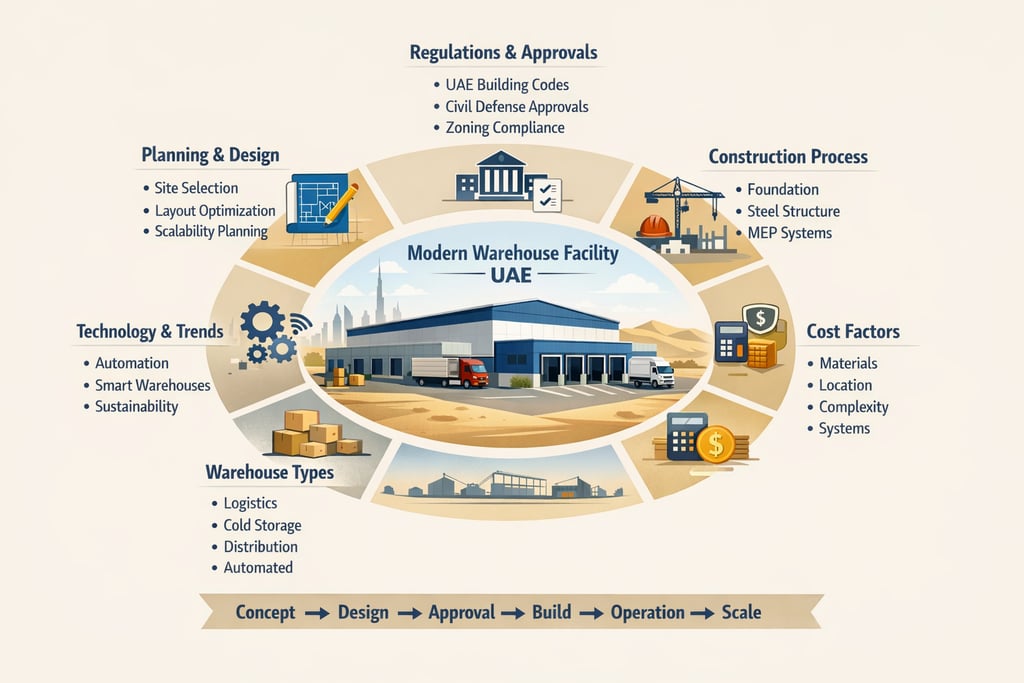
Warehouse Construction Companies UAE
If you’re planning a warehouse in the UAE, you’re not just building a structure. You’re creating the backbone of a logistics or industrial operation. That changes how every decision should be made.
Let’s break down what truly matters when choosing and working with warehouse construction companies in the UAE, from design to compliance and long-term performance.
What do warehouse construction companies in the UAE actually do?
Warehouse construction companies in the UAE handle the full lifecycle of industrial building projects, including planning, design, engineering, approvals, construction, and handover. They also ensure compliance with local regulations and operational requirements.
At a basic level, these companies build warehouses. But in reality, their role is far more technical and strategic.
They coordinate architects, structural engineers, MEP specialists, and regulatory authorities. This is essential in the UAE, where construction is tightly controlled by municipal bodies and building codes.
For example, every project must comply with national and emirate-level regulations covering fire safety, structural integrity, and energy efficiency. UAE building codes overview These standards ensure that warehouses can withstand environmental conditions and operational stress.
Beyond compliance, good contractors also focus on efficiency. They design layouts for workflow, storage optimization, and future scalability.
In short, they don’t just build walls. They build systems that support your business.
If you’ve already explored broader Construction Services in UAE, you’ll notice that warehouse development sits within a much more specialized segment of the industry.
While general contractors may handle residential or commercial builds, warehouse construction demands deeper expertise in industrial layouts, load-bearing design, and logistics flow planning.
This is where many projects go wrong, businesses assume all construction services are interchangeable.
In reality, warehouse projects require contractors who understand operational efficiency, not just structural delivery.
Why is the UAE a major hub for warehouse construction?
The UAE is a global logistics hub due to its strategic location, advanced infrastructure, and strong trade ecosystem, driving high demand for warehouses across sectors like e-commerce, manufacturing, and distribution.
The UAE sits between Asia, Europe, and Africa. That alone makes it ideal for logistics.
But the real advantage comes from infrastructure. Industrial zones like Dubai Industrial City overview and Khalifa Economic Zones Abu Dhabi are purpose-built for manufacturing and storage.
These zones offer:
Direct access to ports and airports
Tax incentives in free zones
Integrated logistics networks
This environment creates constant demand for modern warehouses.
E-commerce growth has added another layer. Businesses now need specialized facilities like fulfillment centers, cold storage, and automated warehouses.
That’s why construction companies in this sector are evolving fast. They’re not just building storage. They’re building supply chain infrastructure.
What types of warehouses are built in the UAE?
Warehouse construction companies in the UAE build various types, including logistics warehouses, cold storage facilities, distribution centers, manufacturing warehouses, and automated smart warehouses.
Not all warehouses are the same. The type you need depends on your business model.
Here are the most common types:
Logistics Warehouses
Used for storage and movement of goods. These are often located near ports and highways.
Distribution Centers
Designed for fast sorting and shipping. Layout and workflow matter more than storage density.
Cold Storage Facilities
Built for temperature-sensitive goods like food and pharmaceuticals. These require specialized insulation and HVAC systems.
Manufacturing Warehouses
Combine storage with production. These require additional safety and utility planning.
Automated Warehouses
Use robotics and AI systems. These need higher ceilings, stronger flooring, and advanced electrical systems.
Each type has unique design requirements. A good construction company understands these differences and plans accordingly.
How do UAE regulations impact warehouse construction?
Warehouse construction in the UAE must comply with strict building codes, fire safety laws, environmental regulations, and municipal approvals, making regulatory expertise essential for contractors.
Regulations are one of the biggest factors in UAE construction.
Every warehouse must meet national and local standards covering:
Structural safety
Fire protection systems
Energy efficiency
Accessibility
These are enforced by municipalities and civil defense authorities.
For example:
Fire safety approvals are mandatory before construction begins
Inspections are required before project completion
Non-compliance can lead to fines or project shutdowns
Warehouse-specific rules also apply.
For instance, guidelines often require:
Minimum ceiling heights
Proper ventilation and skylight ratios
Dedicated industrial zoning
Environmental regulations are also becoming stricter. Warehouses must now consider sustainability, waste management, and energy use.
This is why experienced contractors are critical. They know how to navigate approvals without delays.
What should you look for in a warehouse construction company?
You should evaluate experience, regulatory knowledge, design capability, project management skills, and past industrial projects when choosing a warehouse construction company in the UAE.
Choosing the right contractor can make or break your project.
Here’s what actually matters:
Industry Experience
Look for companies with proven warehouse or industrial projects. Residential experience doesn’t translate well here.
Regulatory Expertise
They should understand local laws, permits, and approval processes. This avoids costly delays.
Design Capability
Good companies don’t just build. They optimize layouts for efficiency and scalability.
Project Management
Timelines are critical. Delays can affect your operations and revenue.
Technology Integration
Modern warehouses often include automation, smart systems, and energy-efficient designs.
Portfolio and Case Studies
Always review past work. Focus on projects similar to yours.
A simple rule: if a company can’t clearly explain your project requirements, they’re not the right fit.
While industrial projects demand scale and efficiency, there’s a parallel demand for high-quality residential builds across the UAE.
Many firms that specialize in warehouses also bring valuable technical expertise from Villa Construction Services Dubai, especially in areas like structural planning, material selection, and regulatory compliance.
This crossover matters more than it seems. Residential construction often requires precision, attention to detail, and design flexibility.
When applied to warehouse projects, these strengths can improve build quality, durability, and long-term performance.
It’s one reason some developers prefer contractors with experience across both industrial and residential sectors.
How much does warehouse construction cost in the UAE?
Warehouse construction costs in the UAE typically range from $40 to $100 per square foot, depending on size, materials, location, and technical requirements.
Costs vary widely based on several factors.
Size and Scale
Larger warehouses reduce cost per square foot but increase total investment.
Location
Free zones and industrial parks may have different land and compliance costs.
Design Complexity
Cold storage and automated warehouses cost significantly more.
Materials
Steel structures are common, but quality and specifications affect pricing.
MEP Systems
Electrical, plumbing, and HVAC systems can add substantial costs.
Compliance Requirements
Fire safety and environmental systems also increase costs.
It’s important to focus on total lifecycle cost, not just construction price.
A cheaper warehouse today may cost more in operations later.
What is the warehouse construction process in the UAE?
The warehouse construction process includes planning, design, approvals, site preparation, construction, inspections, and final handover, with regulatory approvals integrated at every stage.
The process typically follows these steps:
1. Planning and Feasibility
This includes site selection, budget estimation, and initial concept design.
2. Design and Engineering
Architectural and structural plans are created. MEP systems are integrated.
3. Approvals and Permits
Plans are submitted to authorities for approval.
4. Site Preparation
Land clearing, grading, and foundation work begin.
5. Construction
The structure is built, followed by systems installation.
6. Inspections
Authorities inspect the project for compliance.
7. Handover
Final approvals are granted, and the warehouse becomes operational.
Each phase must align with regulatory requirements.
Skipping steps or rushing approvals can cause major setbacks.
How climate affects warehouse construction in the UAE
The UAE’s extreme heat, humidity, and dust conditions require specialized materials, insulation, ventilation, and structural design for warehouses to ensure durability and operational efficiency.
This is one of the most overlooked factors.
The UAE climate is harsh. Temperatures can exceed 45°C.
This affects:
Building materials
Insulation systems
Cooling requirements
Worker safety
Warehouse designs must include:
Heat-resistant roofing
Proper ventilation systems
Energy-efficient cooling
Dust is another challenge. It impacts equipment and storage conditions.
Experienced construction companies account for these factors from day one.
What trends are shaping warehouse construction in the UAE?
Key trends include automation, sustainability, smart warehouses, modular construction, and demand for e-commerce fulfillment centers.
The industry is changing fast.
Automation
Warehouses are becoming more tech-driven. Robotics and AI systems are now common.
Sustainability
Green building standards are becoming mandatory in many areas.
Modular Construction
Faster build times and cost efficiency are driving adoption.
E-commerce Growth
Demand for last-mile delivery hubs is rising.
Smart Warehouses
IoT systems are improving tracking, efficiency, and energy use.
Construction companies that adapt to these trends offer better long-term value.
How to choose the right warehouse design for your business
The right warehouse design depends on your operational flow, storage type, scalability needs, and technology integration requirements.
Before you build, you need clarity.
Ask yourself:
What type of goods will you store?
How fast do you need to move inventory?
Will you scale in the future?
Your answers shape the design.
For example:
High-volume businesses need efficient layouts
Cold storage requires specialized insulation
Automated systems need higher ceilings
A good construction company will guide you through these decisions.
Frequently Asked Questions
What is the average timeline for warehouse construction in the UAE?
Most warehouse projects take 4 to 12 months depending on size, approvals, and complexity. Delays usually happen during the approval phase, not construction itself.
Do I need special approvals for warehouse construction in Dubai?
Yes. You need approvals from Dubai Municipality, Civil Defense, and sometimes free zone authorities. Each project must meet strict safety and zoning regulations.
Can foreign investors build warehouses in the UAE?
Yes. Foreign investors can build warehouses, especially in free zones where 100% ownership is allowed. Mainland projects may require local partnerships depending on the structure.
What materials are commonly used in UAE warehouses?
Steel structures are widely used due to durability and speed of construction. Concrete is used for foundations and flooring, especially in heavy-load facilities.
Are sustainable warehouses required in the UAE?
Sustainability is increasingly mandatory. Many projects must comply with green building standards, especially in Abu Dhabi and Dubai.
How do I reduce warehouse construction costs?
Focus on efficient design, choose the right location, and work with experienced contractors. Avoid overdesigning features you don’t need.
Final Thoughts
Building a warehouse in the UAE is not just a construction project. It’s a strategic investment in your supply chain.
The companies you choose will influence everything, from cost to performance to long-term scalability.
If you take one thing from this guide, let it be this: the best warehouse construction companies don’t just build faster. They build smarter, with your business goals in mind.
About The Author
Mubashir Shakoor Godha is a blogger, digital marketer, and SEO specialist based in Pakistan. He started his journey in 2019 on Blogger and has since built and managed multiple websites that rank on Google and AI driven search platforms.
He is also the Founder of MSG Digitals, Top Rated Digital Marketing Agency in Pakistan, where he helps businesses grow through SEO, content strategy, and performance marketing.

Is a leading construction company in the UAE, delivering 100% results-driven solutions across the Energy and Industrial sectors. We empower a rapidly growing UAE to reach new heights.
call us
Tel: +971-25656302
Mail Us
Quick Links

Contact Us
Powered by MSGDigitals.com